Symi, Greece: What It Costs, How to Get There, Who It Suits
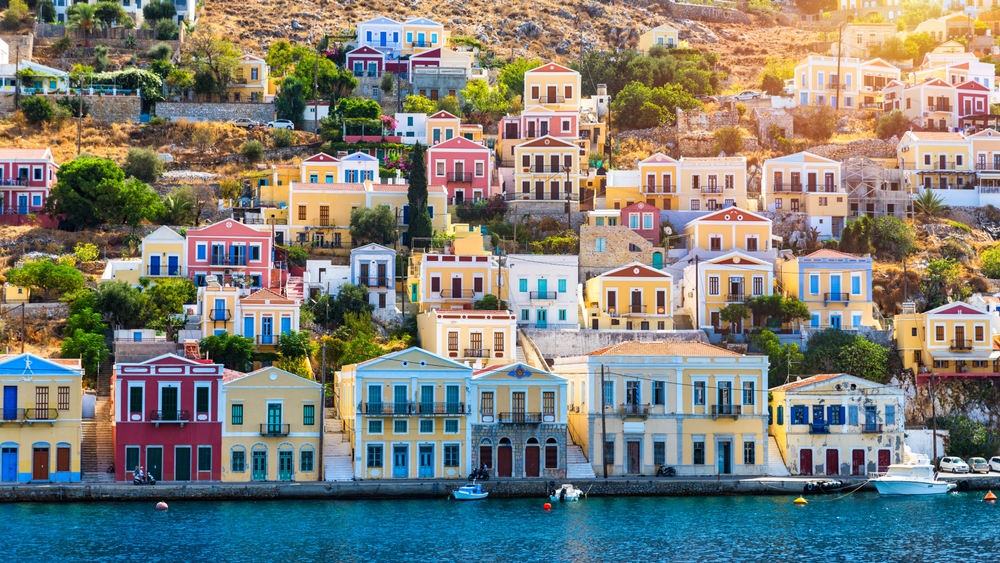
Symi has no airport, and that one fact shapes the whole trip. You fly to Rhodes, get on a boat, and forty-five minutes later you are looking at a steep bowl of painted mansions, 2,600 people, and five hundred stone steps climbing out of the harbour. Here is what it costs, how you reach it, and who it suits.
How do you get to Symi?
You get to Symi by boat from Rhodes. There is no airport on the island, so every trip runs through Rhodes: fly into Rhodes International (RHO), then cross by ferry or catamaran. The quickest boats take about 45 minutes, and tickets start from around €7 one way.
That single fact shapes the whole trip, so it is worth sitting with for a moment.
So if you are searching for flights to Symi, there are none to find, and that is not an oversight in the timetables. Rhodes and Kos are the only two islands in the Dodecanese with international airports. Six more islands have small airports served from Athens. Symi is in the third group: the seven islands you can only reach on water. We set out how all twelve Dodecanese islands compare in a separate guide, including which ones you can fly into. None of that makes Symi hard to visit. It does mean you cannot land at breakfast and be swimming by ten, and it means leaving a buffer before your flight home, because out here the wind occasionally wins.
The practical version
- Fly to Rhodes (RHO), which takes direct flights from across Europe
- Cross to Symi from Rhodes Town’s main port
- Fastest crossing: about 45 minutes on the Dodekanisos Seaways catamaran
- Slower conventional ferries take 1 hour 20 minutes to 1 hour 30 minutes
- Around 22 sailings a week in season, run by Dodekanisos Seaways, Blue Star Ferries, SAOS Ferries and others
- Foot passenger fares start from about €7 one way
If you have a night either side of the crossing, Rhodes Town and its medieval quarter are worth the stop.
Boats dock at Gialos, the main harbour. Some also stop at Panormitis, the monastery bay on the south of the island. Handy if the monastery is why you came, a nuisance if your hotel is in town.
What does a trip to Symi cost?
Symi sits in the middle of the Greek island price range. It is not Santorini, and it is not the cheapest corner of the mainland either. Here is what the island itself charges, as of August 2026.
| What | Price |
|---|---|
| Ferry from Rhodes, one way | from €7 |
| Bus, Gialos to Chorio or Pedi, one way | €2.50 |
| Water taxi to a beach and back | €10–€17 |
| Average hotel night | €64 |
| Three-star hotel night | €72 |
| Meal, inexpensive restaurant | €10 |
| Three-course dinner for two, mid-range | €63 |
| Draught beer, 0.5 litre | €5 |
| Cappuccino | €3.50 |
| Bottle of water, 0.33 litre | €0.69 |
Island prices from hikersbay, updated 24 August 2026. Ferry fares from Ferryhopper. Treat these as a middle, not a ceiling: July and August run higher, and a harbourfront table costs more than the same meal one street back.
Put those together for a couple staying three nights. Three hotel nights at €64 is €192. Return crossings for two at €7 each way is €28. Three dinners at €63 and six cheap lunches at €10 is €249. That comes to roughly €470 before flights, and the number moves with the season and how close to the water you sit.
For the wider picture, we break down what a trip to Greece costs end to end.
An organised day trip from Rhodes costs a fraction of that, and buys you a fraction of the island. That can be a perfectly fair trade, as long as you know you are making it. More on that below.
What pushes the bill up
Two things cost more than people expect. The first is the harbourfront itself: the tables with the best view of the painted houses charge for it, and the difference is real. The second is water. Symi has almost none of its own, and everything trucked or shipped in shows up somewhere in the price.
Is Symi worth visiting?
Yes, if you want a beautiful harbour and a slow week. No, if you want a big beach holiday with a lot of choice.
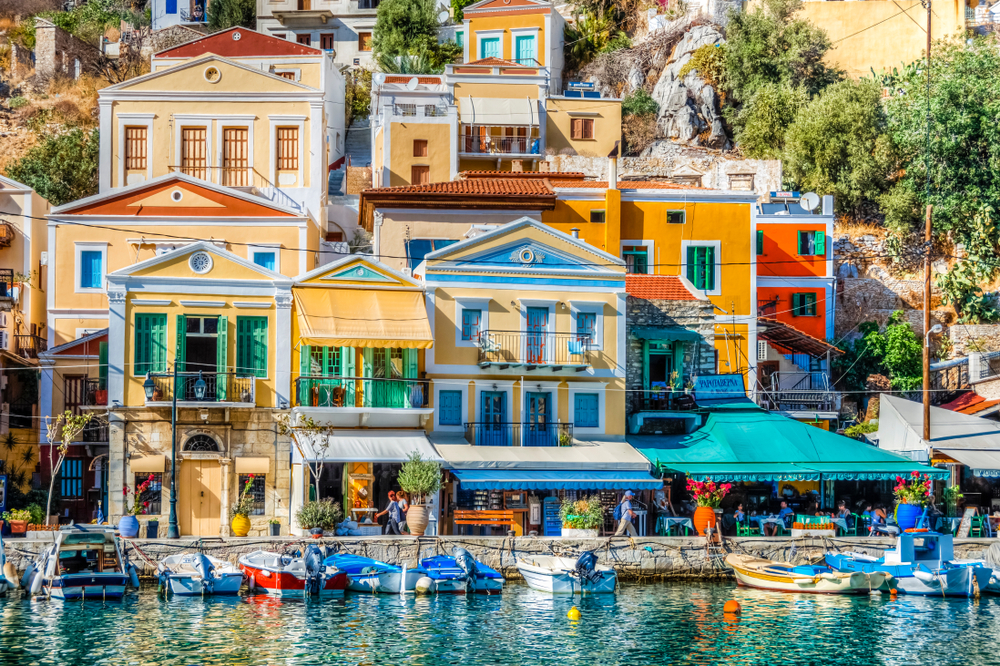
Symi’s draw is one specific thing, and it is genuinely rare. The harbour at Gialos is a bowl of steep hillside packed with tall neoclassical houses. They come in ochre, cream, deep red and faded blue, stacked above each other and doubled in the water. Most Greek islands are whitewashed cubes. This is not that. It is the most colourful harbour in Greece and it looks more like a small Italian port that drifted east, which is roughly what the history says happened.
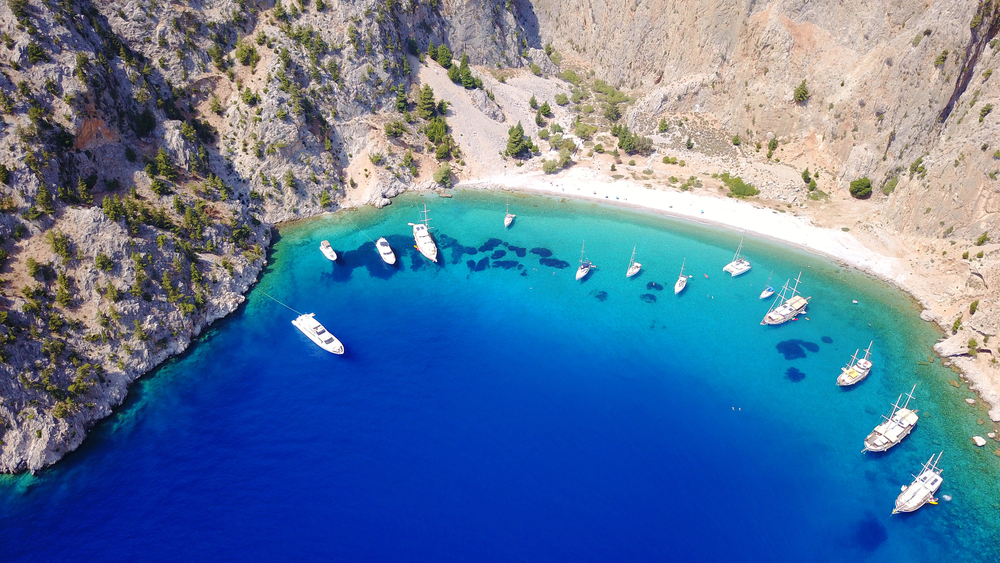
What Symi does not have is a long list of beaches. The island is rocky and steep, its coastline cut into small bays rather than broad sweeps of sand, and most of the good swimming is reached by boat rather than by road. Two exceptions are walkable: Nos, about 650 metres along the road from the clock tower, and Nimborio, a sheltered bay three kilometres west of Gialos that you can reach on foot, by road or by boat. If your holiday needs a beach club and twelve restaurants to choose between, you will run out of island by day three. That is a question of fit rather than a fault, and we keep a list of Greek islands that disappoint certain travellers with what to book instead.
The 500 steps, and why they decide your trip
Symi town is two towns. Gialos is the harbour, at sea level. Chorio is the old village on the ridge above it. Between them runs the Kali Strata, a staircase of roughly 500 wide stone and marble steps. The climb takes 15 to 30 minutes, depending on your pace and how often you stop.
This matters more than any guide usually admits.
The slope carries almost no shade, and in the warm months the midday sun on those steps is punishing. Early morning and the hour before sunset are the sensible times to climb. The steps are lit after dark, so an evening walk up after dinner works well.
Before you book, be honest about who is coming. If someone in your group has bad knees, a heart condition, or is pushing a buggy, the Kali Strata is not a charming detail. It is the thing that decides whether they see half the town or all of it. There is a road, and taxis do run, but the staircase is the direct route and the one everybody photographs. If steps are a genuine constraint, start with our guide to the easier Greek islands for older couples, and the Greece for seniors pages set out how we work around walking limits.
Getting around once you are there
You do not need a car on Symi, and most people are better off without one.
Two bus routes cover almost everything worth reaching. The first runs from Gialos up to Chorio and on down to Pedi, hourly from 8am with no 3pm service, and it costs €2.50 one way. It takes ten minutes to Chorio and twenty to Pedi. That bus is also the answer to the Kali Strata: if the steps are too much in one direction, ride up and walk down.
The second goes to Panormitis monastery. Three services each way a day in high season, two in low, forty minutes each way, €10 return. The road there is winding, which is a good reason to let somebody else drive it.
For the beaches you want a boat rather than a road. Water taxis leave Gialos at 10am, 11am, noon and 1pm, calling at Agia Marina, Agios Nikolaos, Agios Georgios Dysalona, Nanou and Marathounta, and come back at 2pm, 4pm, 5pm and 6pm. Return fares run €10 to €17 depending on distance. From Pedi the hop to Agios Nikolaos or Agia Marina goes every twenty minutes or so once there are enough passengers, five to ten minutes each way, €7 to €8 return.
There is a taxi rank in Gialos. Agree the fare before you set off, because the meters often are not used.
And a fair amount is walkable. The harbour front takes about twenty minutes end to end. Gialos to Pedi over the hill through Chorio is about forty-five minutes, and Pedi to Agios Nikolaos another twenty along the shore.
Why the houses are grander than the island
Symi today has a permanent population of 2,603, recorded in the 2021 census. In the nineteenth century it peaked at around 22,500.
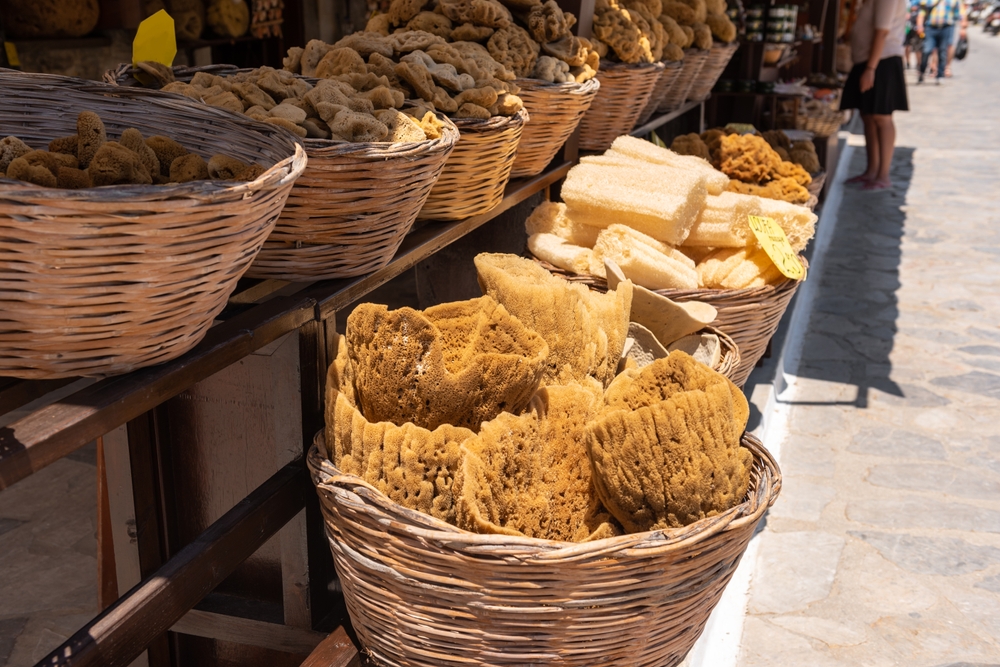
That is nearly nine times as many people as live there now, on an island of about 58 square kilometres. The wealth came from sponges:
“Symi was noted for its sponges, which provided much of its wealth.” Wikipedia, Symi
Symi’s divers and its shipbuilding yards made the island rich enough to build the mansions you now see stacked around the harbour, and rich enough to build them in a style that owed nothing to the rest of the Aegean.
Then the sponge trade collapsed, the wars came, and the people left. The houses stayed. That gap between the buildings and the people is the most interesting thing about walking around Symi, and once you know the number you start seeing it everywhere: streets of fine doorways with nobody behind them, a scale of building the island today would never attempt.
What is there to do on Symi?
Four things, and they fill a week comfortably if you are not in a hurry.
Walk the town. Gialos and Chorio are the main event. Give yourself a full morning to wander the lanes above the harbour without a route, then come back at dusk when the low sun catches the paintwork.
Get to a bay by boat. This is how most swimming works on Symi. Water taxis run from Gialos and from Pedi, and they call at Agios Nikolaos, Agia Marina, Nanou, Marathounta, Agios Georgios Dysalona and Nimborio. If you would rather not board anything, Nos is a short walk from the clock tower and Nimborio is a longer one, though Nos is pebbly and, being the closest, tends to be the busiest. Pay for the round trip and agree your pickup time before you step off. Cash is the norm on the waterfront.
Visit Panormitis. The monastery of Saint Michael sits in a bay on the south of the island and draws visitors from well beyond Greece. Many Greeks come to pay their respects each year. Some ferries from Rhodes stop there directly, which is worth checking when you book. Patmos, another Dodecanese island with no airport, has a monastery of similar standing.
Walk out of town. Old paths cross the island between the bays. They are dry, exposed and hot in summer, so treat them as an early-morning thing and carry more water than feels necessary.
What you will not find is a nightlife strip or a row of beach clubs. Evenings on Symi are dinner, a drink by the water, and the walk home.
What to eat, and the one thing to order
Order the shrimp. Every other restaurant on Symi is good in the ordinary way that Greek island food is good; the shrimp is the reason people talk about eating here.
Symi shrimp are tiny, four to five centimetres, and they come to the table without heads because at that size there is nothing in a head worth keeping. They are crimson, faintly ribbed, and slightly sweet. The shell is soft enough to eat, so they arrive fried whole and you eat them the same way, shell and all. Boiled with lemon and oil is the other common treatment. The bravest option is straight from the net with an ouzo, which is how the fishermen deal with them.
They are not a marketing invention. They live in the stony shallows around the island, anywhere from two metres down to two hundred, thickest along the north coast between Seskli and Ai-Milianos. You will find them in Rhodes and Karpathos too, but Symi is where they are the local dish rather than an import.
Beyond that, look for gaelopita, a pie stuffed with small fish, and lachanondolmades, which are stuffed vine leaves made with white cabbage instead. For something sweet, akoumia sit somewhere near a doughnut.
Day trip or stay the night?
Most visitors to Symi arrive on a day boat from Rhodes, spend three and a half to four hours ashore, and leave. The boats are big: some carry up to 420 passengers.
Do the arithmetic and the pattern is obvious. For a few hours in the middle of the day, a harbour belonging to 2,600 people holds several boatloads of visitors. Then the boats go, and it belongs to 2,600 people again.
Stay the night and you get the island either side of that window. Early morning, when the fishing boats are working and the tavernas are setting up. Evening, when the harbour empties and the houses hold the last of the light. That is the Symi people are describing when they say they fell for it.
A day trip is not a bad choice at all. If Rhodes is your base and your time is short, take it and enjoy it. Just know that you are seeing the busiest four hours of Symi’s day, and that the thing the island is famous for happens outside them.
Where to stay: Gialos, Chorio or Pedi
Three places, and the five hundred steps decide between them more than anything else does.
Gialos is the harbour, at sea level, and it is where most people stay. Everything arrives here and most of the tavernas are here. The trade-off is that it is also where the day boats unload, so the busiest four hours of the island happen outside your door. The compensation is that they leave, and the evening harbour is the thing you came for.
Chorio is the old village on the ridge. Quieter, older, and with the view down over the bowl that the harbour cannot give you. But every trip down to the water is five hundred steps, and every trip back is five hundred steps up. The bus solves it for €2.50 and ten minutes, and plenty of people ride up and walk down. Just be honest about doing that twice a day for a week.
Pedi is a small bay twenty minutes from Gialos by bus, with a beach at the end of it. It suits you if swimming matters more than the harbour view, and if you would rather be twenty minutes from the crowd than in it. Boats run from Pedi to Agios Nikolaos and Agia Marina every twenty minutes or so for €7 to €8 return, which makes it the easiest base for beach days.
The short version: Gialos for a first visit, Chorio if you want the quiet and can manage the climb, Pedi if the point of the trip is swimming.
Who Symi suits, and who it does not
It suits you if you want a quiet base for a week and you like walking. The same goes if you would rather have one beautiful thing than twelve adequate ones, and if you are happy eating in the same few tavernas until you know them.
It suits couples well. The harbour at night does most of the work.
It suits confident swimmers and small-boat people. The best bays are reached by water taxi, and that is part of the pleasure rather than a chore.
If quiet is the whole point of the trip, weigh Symi against the other Greek islands where almost nothing happens. It also works better inside a longer Dodecanese route than as a stand-alone week, and it is one of the islands we build Greece itineraries around.
Think twice if you are travelling with someone who cannot manage steps and steep ground. Think twice if you need a wide choice of restaurants and nightlife, or sandy beaches you can drive to. Kos or Rhodes will serve you better on all three counts, and both are close.
Think twice if it is your first trip to Greece and you only have a week. Symi rewards a second or third visit, when you already know what a Greek island holiday feels like and you want a particular version of it.
When to go
Late May to mid-June and September are the best weeks. The sea is warm enough, the day boats are running, and the harbour is not at full pressure. Our notes on September weather across Greece and on which islands peak in May cover the detail.
July and August are hot, and on a treeless island with 500 steps in the middle of town, heat is not a small factor. Prices are also at their highest. If summer is your only option, plan around the middle hours: swim or rest from noon until four, and save the walking for early morning and the evening.
Winter is quiet in the literal sense. Many places close, ferry crossings thin out, and the weather can hold boats in port. It is a real island out of season, not a resort in low gear, which some travellers love and others find bleak.
Choosing Symi
Symi rewards one kind of traveller and quietly disappoints another, and that is the most useful thing anyone can tell you before you book. If you want a beautiful harbour, a slow week and a boat ride to your swimming, few islands in Greece will suit you better. If you want sand you can drive to and twelve restaurants to choose between, Kos is forty-five minutes away and will make you happier.
The steps are the honest dividing line. Walk them in your head before you book, and most of the decision makes itself.
If Symi is going into a longer Greek itinerary, our guide to planning a trip to Greece covers the ferry timings and the order to travel in.
Prices checked August 2026. Re-check the cost table and the ferry times each spring, before the season starts.
Frequently asked questions
Does Symi have an airport?
No. Symi has no airport. The nearest one is Rhodes International Airport, and you reach Symi from Rhodes Town by ferry or catamaran. The fastest crossing takes about 45 minutes. Six other Dodecanese islands do have small airports, but Symi is one of the seven you can only reach by boat.
How long does the ferry from Rhodes to Symi take?
Between 45 minutes and about 1 hour 30 minutes, depending on the boat. The catamarans run by Dodekanisos Seaways are the quickest at around 45 minutes. Conventional ferries take roughly 1 hour 20 minutes to 1 hour 30. There are around 22 sailings a week in season.
Is Symi expensive?
Symi is mid-range for a Greek island. An average hotel night runs about €64 and a three-course dinner for two about €63, with a cheap restaurant meal around €10. The ferry from Rhodes starts from about €7. Harbourfront tables and the July to August peak both push those figures higher.
How many steps is the Kali Strata?
Roughly 500 wide stone and marble steps, climbing from the harbour at Gialos to the old village of Chorio. The walk takes 15 to 30 minutes depending on pace. There is almost no shade, so early morning or the hour before sunset are the comfortable times to do it.
Is one day enough for Symi?
One day shows you the harbour, which is the headline. It does not show you the island. Day boats give you three and a half to four hours ashore, all of it in the busiest part of the day. Staying at least one night gets you the early morning and the evening, which is when Symi is at its best.
What is Symi known for?
The painted neoclassical houses stacked around Gialos harbour, the Panormitis monastery on the south of the island, and its sponge-diving past. That trade made Symi wealthy in the nineteenth century, when about 22,500 people lived there. It paid for the grand houses that still line the harbour.
Feeling Ready?
From our blog
Aliki Beach, Paros: Three Beaches, One Name
READ MORE
Ioannina, Greece: The Lake City Between Athens and Corfu
READ MORE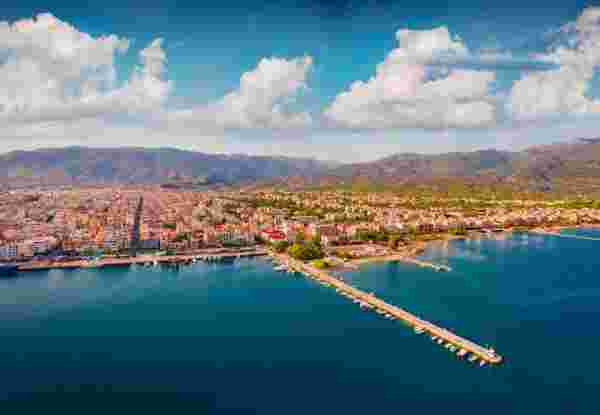
Kalamata, Greece: How to Get There, What to See, When to Go
READ MORE
Logaras Beach, Paros: Where to Swim When the Sun Bites
READ MORE
Athens to Santorini: Ferry or Flight? (2027 Guide)
READ MORE
Athens to Santorini: Ferry or Flight? (2027 Guide)
READ MORE
Piso Livadi Beach, Paros: Sand, Tavernas and the Boat Out
READ MORE
Aegina, Greece: A Practical Island Guide (2026)
READ MORE
Spetses, Greece: Everything you need to know (2026)
READ MORE