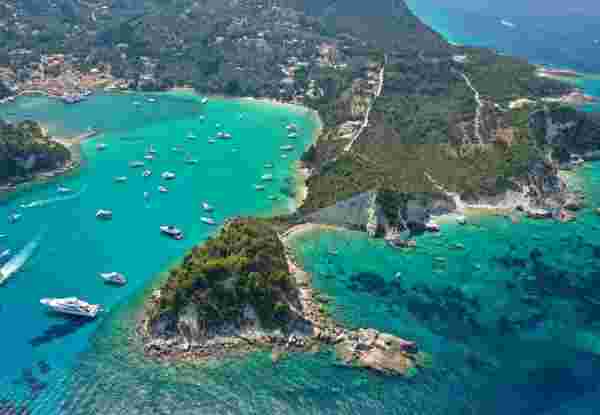
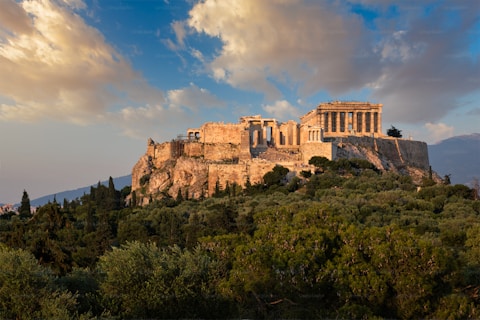
Kefalonia: Complete Guide to Greece’s Largest Ionian Island
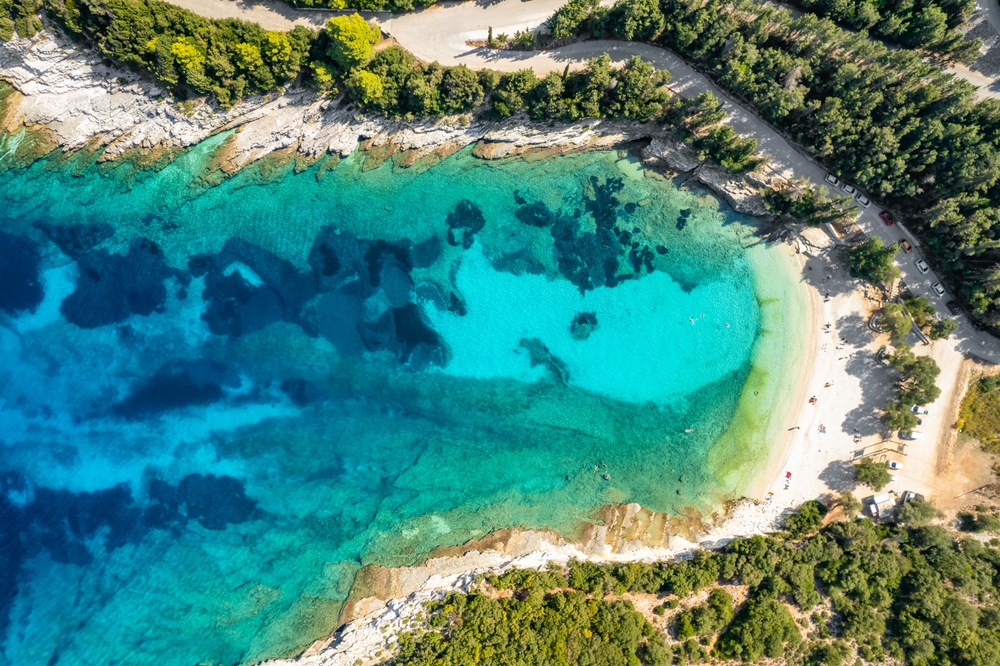
Kefalonia easily stands out as one of the best islands in Greece to visit! Quite big with a vibrant population, dotted with charming towns and villages, hugged by beautiful beaches and offering an amazing local culture and cuisine, Kefalonia should be high in your list of islands to visit while in Greece!
In this guide, we will discuss everything about planning the best Kefalonia holidays! We will talk about what makes this island unique, how to reach it, the best time to go, where to stay, what to do while there, the best beaches and activities and of course, the food!
Let’s get into it!
What is Kefalonia famous for?
Kefalonia is widely known as the filming location of the classic, Captain Corelli’s Mandolin film, and is often included in a well-rounded trip to Greece thanks to its natural beauty and cultural highlights. But Kefalonia is also home to the underground Melissani Cave, the Mount Ainos National Park, the beautiful Myrtos Beach and for its delicious, local wine variety, Robola. It’s the biggest island in the Ionian Archipelago and 6th biggest in Greece overall. Its capital is the town of Argostoli, home to the longest stone bridge over seawater in the world (De Bosset Bridge).
Where is Kefalonia and How to Get There
Kefalonia lies in the Ionian Sea, out from the west coast of Greece. To be more specific, it is situated between Lefkada and Zakynthos, on the southern end of the island chain. You can reach it by plane from Athens and Thessaloniki or by ferry from Kylini port in the Peloponnese. Kefalonia also offers good connectivity with surrounding Ionian islands, making it a great base for group trips to Greece with friends and island hopping.
Athens to Kefalonia by Plane
The most straightforward option is to reach Athens to Kefalonia by plane. It’s also what most tourists do. They spend a couple of days exploring the capital of Greece before moving on to the islands.
You can take a direct flight from the Athens International Airport with Aegean, Olympic or Sky Express and land on the island in less than an hour. Flights take place year round, with more available from May to October. You will land at the Kefalonia International Airport (Anna Pollatou, code EFL). You can take a taxi or a bus to Argostoli, 8km away.
Athens to Kefalonia by Ferry and Bus
There are no direct ferries from Athens to Kefalonia. If you want to reach the island by boat, you will have to go to the Kyllini port, either by renting a car or by taking a KTEL bus. This small town lies around 3,5 – 4,5 hours away from Athens. You can take a ferry from there and arrive in Poros in southeast Kefalonia in 1,5 hours.
An alternative and less popular option, is travelling to Patras, by car, bus or train and taking the ferry to Sami, on the east coast of Kefalonia. This ferry trip takes longer, 3 hours but if you plan on exploring Melissani Cave or Mount Ainos, then Sami would be a very useful arrival point.
Total travel times range between 7 – 9 hours, depending on your preferred route and available connections.
Corfu to Kefalonia and Other Islands
During the tourist season, from May to October, you can reach Kefalonia from the island of Kerkyra as well, with available direct flights. The route takes about 40 minutes, but it’s not available outside of summer. This is the best way if you want to explore Kerkyra as well, before moving on to Kefalonia.
In high season, you can do some island hopping in the Ionian Archipelago. Common routes run from Corfu to Lefkada (by bus or car, as Lefkada connects to the mainland by bridge) and then Kefalonia, with seasonal ferries linking the southern Lefkada port of Vasiliki to Fiskardo.
International travelers can also reach Kefalonia directly by ferry from Bari in Italy. The seasonal route runs from spring through autumn and connects Bari to Sami, with crossings of around 14 – 16 hours. It’s a popular choice for travelers driving from Italy or combining Greece with a wider European road trip.
When is the Best Time to Visit Kefalonia
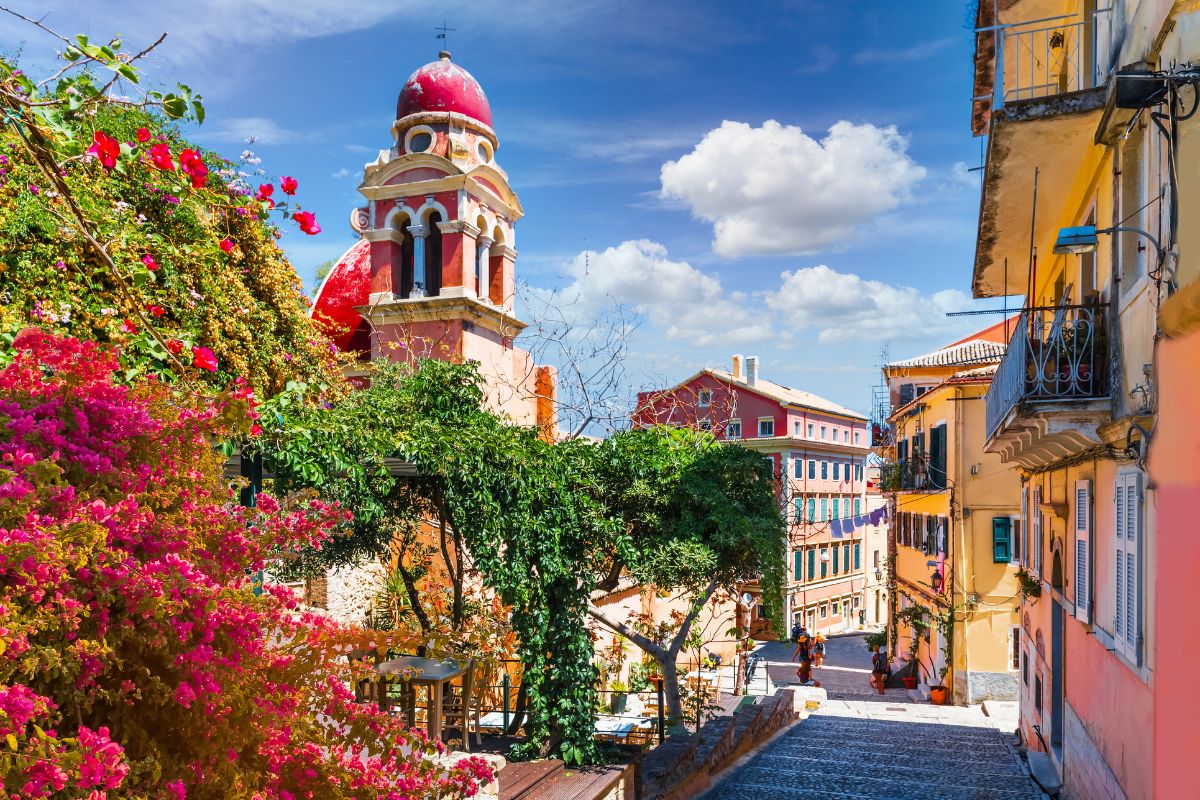
The best time to visit Kefalonia is from late May – June or September. These periods offer the best balance of fine weather, swimmable seas and thin crowds, making them ideal for senior travel experiences in Greece! You can explore the island, enjoy the beaches and tour sights and monuments without the hassle of the strong summer heat and the multitudes of tourists visiting the island. But, other seasons offer their own advantages as well.
Kefalonia Weather by Season
Spring (April – May) features temperatures ranging from 16 – 24°C (61 – 75°F), while the water remains fresh at 16- 19°C (61 – 66°F).
Summer (June – August) is hot and crowded with temperatures between 25 – 30°C (77 – 86°F) and 24 – 26°C (75 – 79°F) for the sea.
Autumn (September – October) is still warm 22 – 25°C (72 – 77°F) with the sea being comfortable for swimming up to October.
Winter (November – March) is cool but rainy, at 11- 15°C (52 – 59°F) however most tourist facilities are closed.
Best Month to Visit Kefalonia
The perfect time for a trip to Kefalonia varies depending on your travel preferences and typical Kefalonia weather conditions. Late May, early June, and September combine warm weather, swimmable sea conditions, and fewer tourists. Beaches will be at their best in July and August, although those two months are also the busiest. April, May, and October are suitable for hiking and exploring Mount Ainos. November to March are the least expensive months but mainly off-season.
Best Kefalonia Beaches
The finest beaches of Kefalonia are located along a coastline of over 250km, where white pebbles rub shoulders with some of the clearest turquoise waters of the Mediterranean. The island has several Blue Flag beaches, and its coastline is a great mixture of postcard-famous bays and red-sand coves, as well as quiet stretches only accessible by a boat or a footpath. Let’s see the best beaches in Kefalonia.
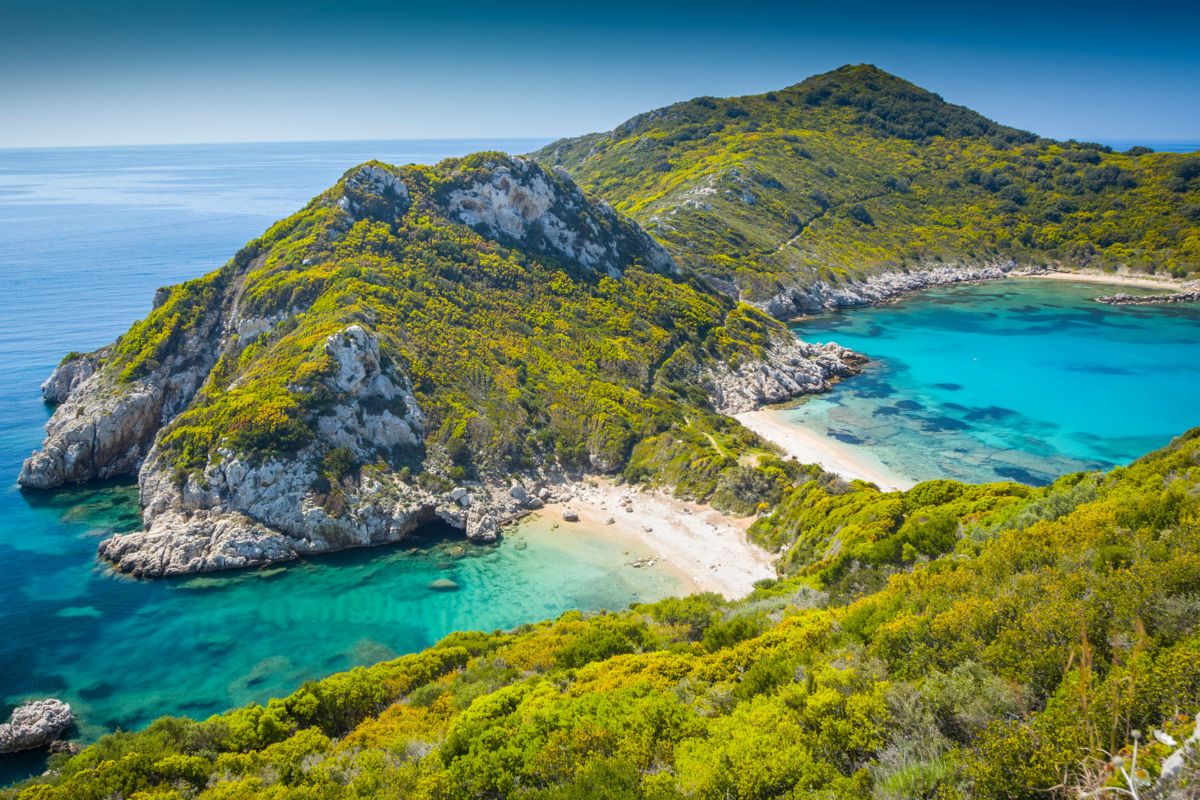
Myrtos Beach
Myrtos Beach is the symbol of the island and a renowned tourist destination in Greece. The long stretch of white pebbles is merged with the crystal clear turquoise water. Tall limestone cliffs that fall vertically into the sea frame the scene. By stepping to the viewpoint from the road, you can take a postcard of the beach.
Best for: photos and the awe factor.
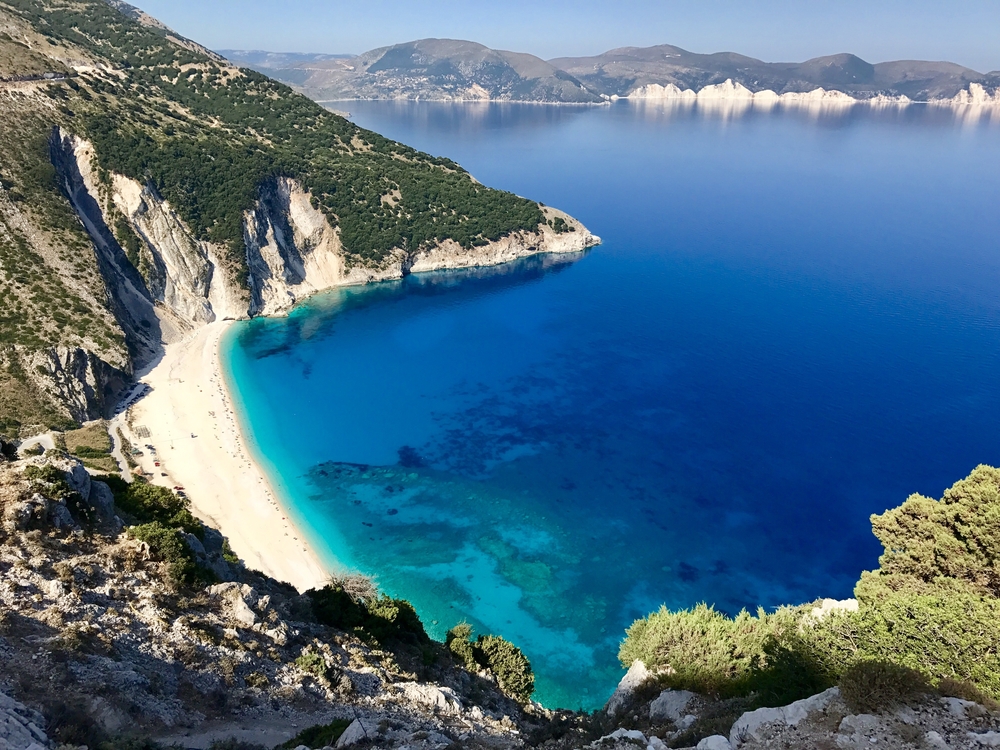
Myrtos Beach, Kefalonia, Greece
Antisamos Beach
Antisamos Beach is located on the east coast near Sami. The shores are pebbly, surrounded by hills and covered with pine trees. The water is clear and deep. The beach was known worldwide after the film Captain Corelli’s Mandolin was shot there. At present, there are some tavernas, sunbeds, and watersports but the natural beauty of the place is not spoiled.
Best for: families and watersports.
Petani Beach
Tucked away in the western Paliki Peninsula, Petani is a long stretch of pale pebbles and brightly colored blue sea, enclosed by cliffs. It is much less crowded than Myrtos although they have the same wow factor. It remains quiet even in August and at golden hour the beach has lovely colors.
Best for: sunset views and less crowded swimming.
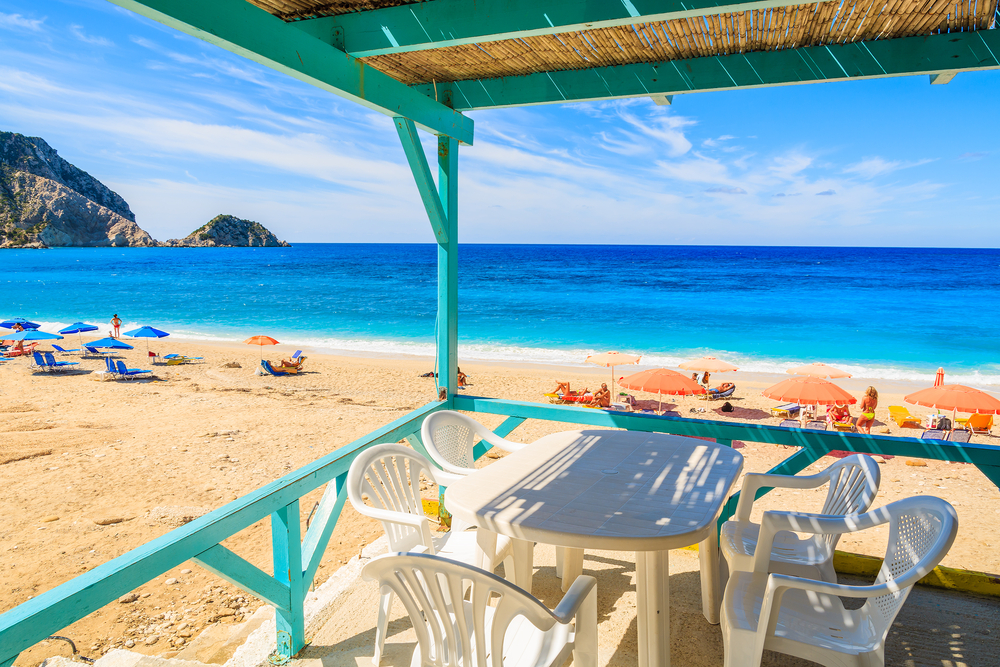
View of Petani beach from local restaurant, Kefalonia island, Greece
Xi Beach
Xi is a very different, long stretch of reddish-orange sand that is very unusual on Paliki Peninsula, together with shallow, calm waters that are waist-deep far from the shore. The clay-rich sand is even used by visitors as a natural beauty treatment. There are tavernas and sunbeds at the back of the beach.
Best for: families with young children.
Skala Beach
Skala is located on the southeast coast of Kefalonia. It’s the longest sandy beach on the island, stretching for almost 3km. The beach is covered with fine pebbles. Besides, the water is shallow and great for children. Another point of attraction is the amenities present at the beach, such as tavernas, bars, and watersports facilities. Also, Roman mosaics from a 3rd-century villa sit nearby
Best for: long-stay beach vacations.
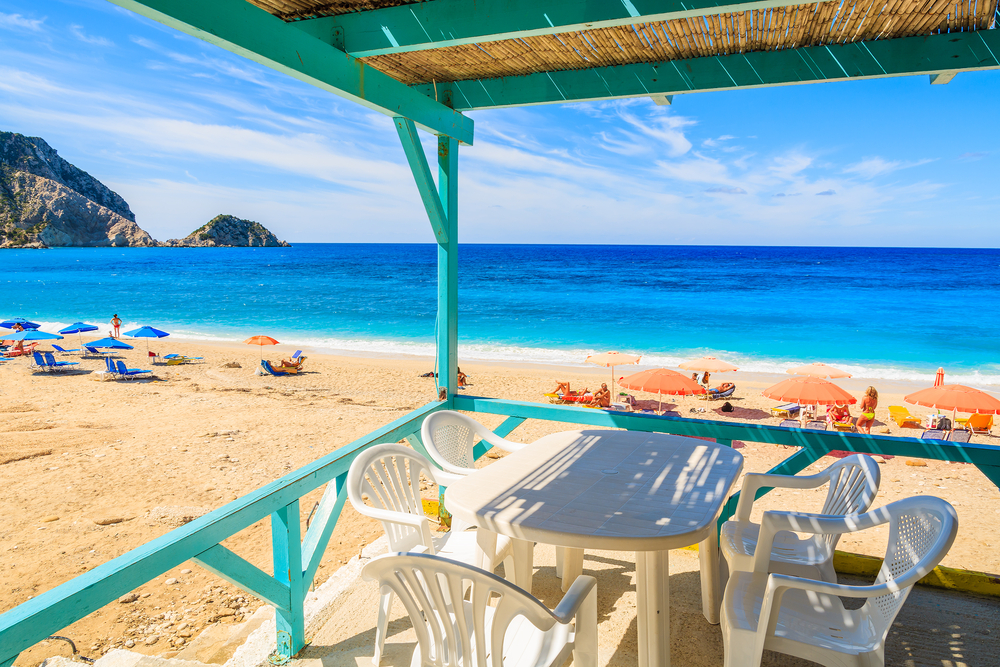
Skala Beach view from above, Cephalonia, Greece. Skala famous beach in Kefalonia island, Greece. Beeautiful Skala beach, Kefalonia island, Ionian sea, Greece.
Makris Gialos and Platis Gialos (Lassi)
These two twin sandy beaches are right outside the Lassi resort, which is just a five-minute drive from Argostoli. You will find here golden sands, calm shallow waters, sunbeds, and a good number of beachfront tavernas and bars. Being close to the capital, they are the most convenient swimming spots of the island.
Best for: easy access from Argostoli.
Foki Beach
This is a small pebbled cove hidden amidst a pine forest just south of Fiskardo. It is widely recognized as one of the places where the endangered Mediterranean monk seal breeds. The shaded path through cypress trees, crystal-clear shallows, and the fantastic snorkeling around the rocky sides make it a nice option for those desiring a quiet place.
Best for: snorkeling and seclusion.
Fteri Beach
Fteri is one of those true secrets of Kefalonia, a strip of impeccable white pebbles and lovely turquoise water on the wild northwest coast. There is no road to the beach. Visitors come either by boat from Agia Kyriaki or they take a steep hiking trail.
Best for: adventurers looking for hidden coves.
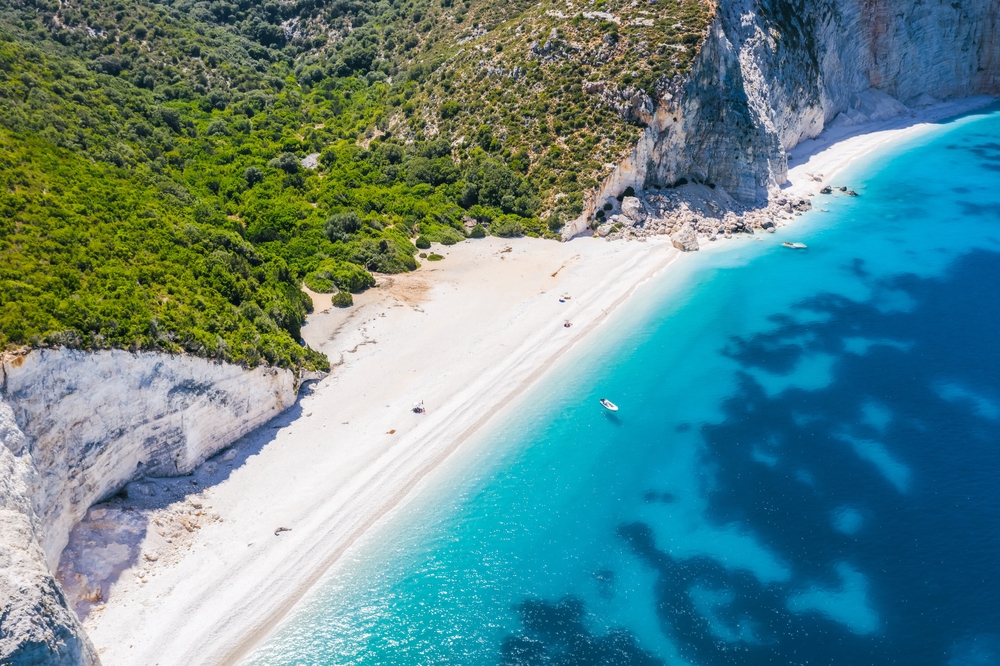
Remote and hidden Fteri beach in Kefalonia Island, Greece, Europe.
Top Things to Do in Kefalonia
The list of activities in Kefalonia goes far beyond the beaches. Request a tailor-made trip to Kefalonia and let local experts design an itinerary that includes these unique experiences. Kefalonia has an underground lake, a 150-million-year-old cave, the highest peak of the Ionian Islands, two of the most beautiful villages in Greece and a series of geological anomalies all packed in one destination which is enough to keep you busy for a whole week.
Visit Melissani Cave
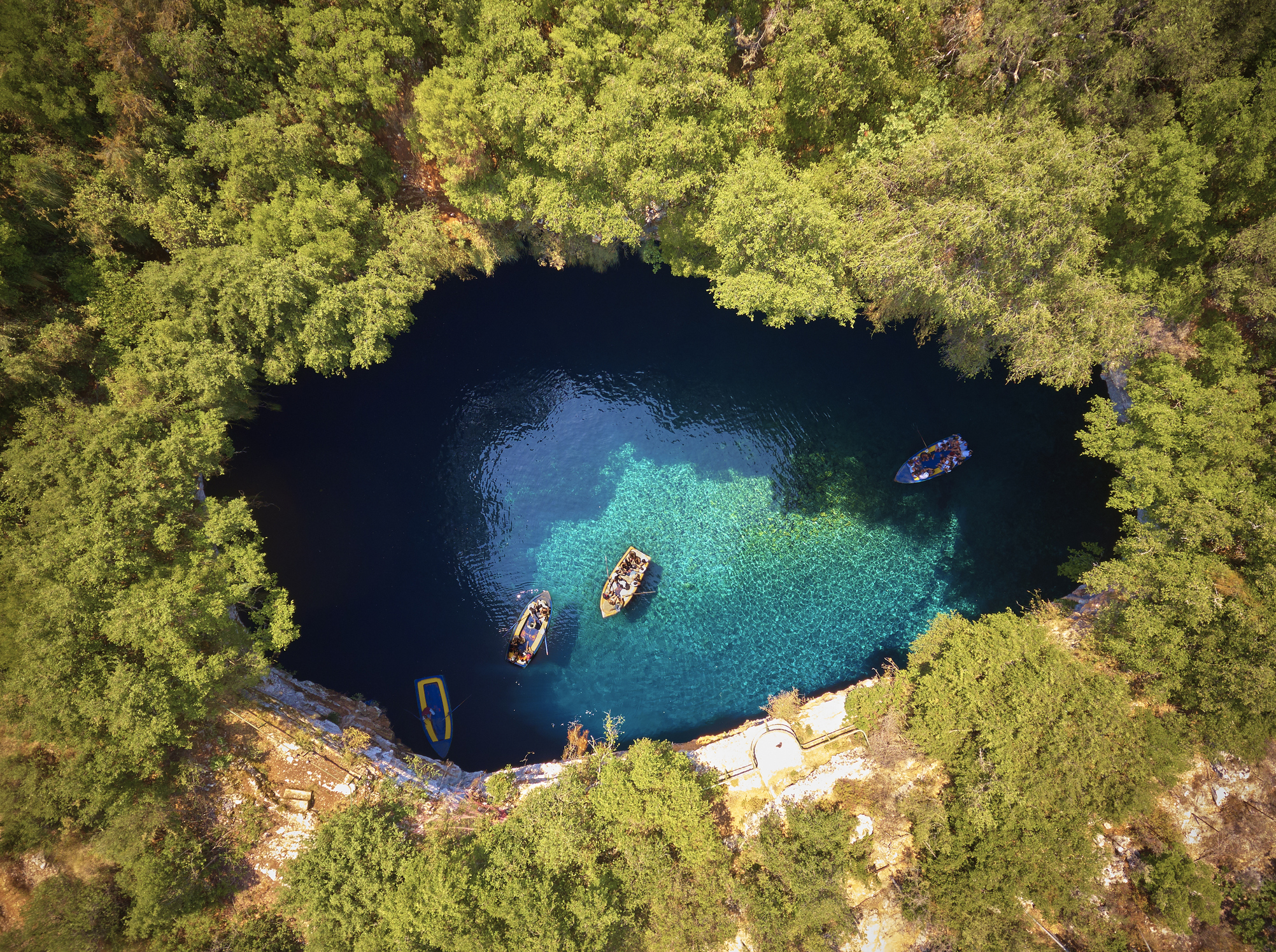
After being revealed in 1951 when part of its roof caved in a quake, Melissani is a hidden lake where sunlight splashes through the cave mouth and turns the water into a stunning electric blue at around noon. Short boat trips continue non-stop and last for approximately 20 minutes. To enjoy the most magnificent light effect, come between 11 AM and 1 PM.
Explore Drogarati Cave
Located just a few minutes away from Sami, Drogarati is a limestone cave that scientists believe to be around 150 million years old, consisting of the most beautiful stalactites and stalagmites. The main chamber, called the Royal Balcony, has exceptional acoustics and is occasionally used for classical concerts. The cave stays at a constant temperature of 18°C all year round, so you might want to wear a light jacket.

Hike Mount Ainos National Park
Mount Ainos is the highest mountain in the Ionian Islands, at 1,628m. One of its major roles is to shelter its precious flora, including the endemic Greek fir (Abies cephalonica), and among its fauna you can find semi-wild horses, descended from ancient herds. Marked paths range from comfortable walks to more challenging ones, with breathtaking views over the Ionian Sea.
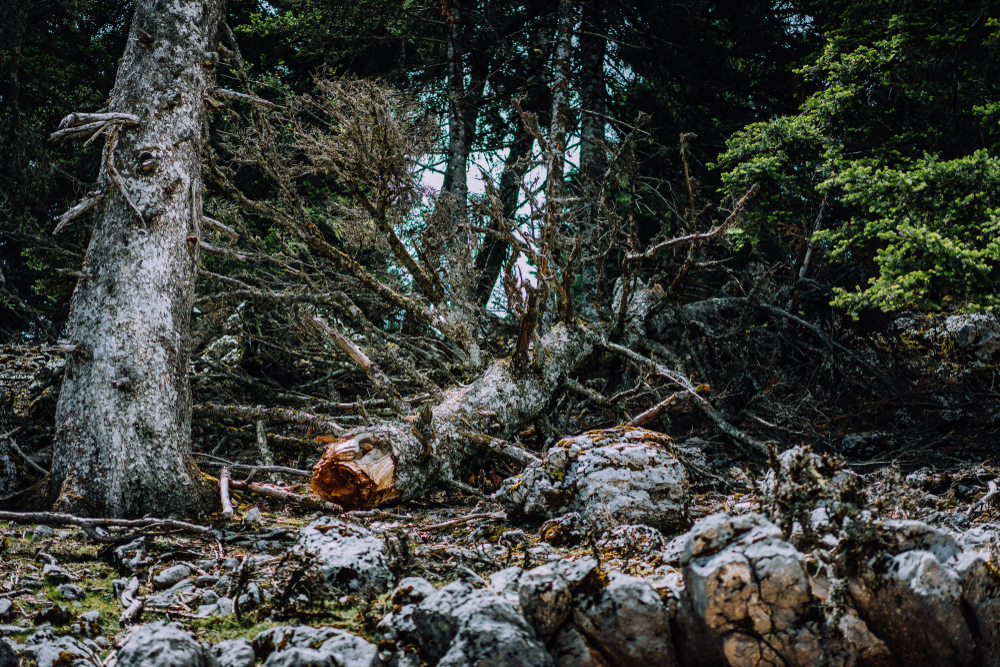
Virgin forest on Kefalonia island. National park with endemic pine trees
Wander Assos and Fiskardo Villages
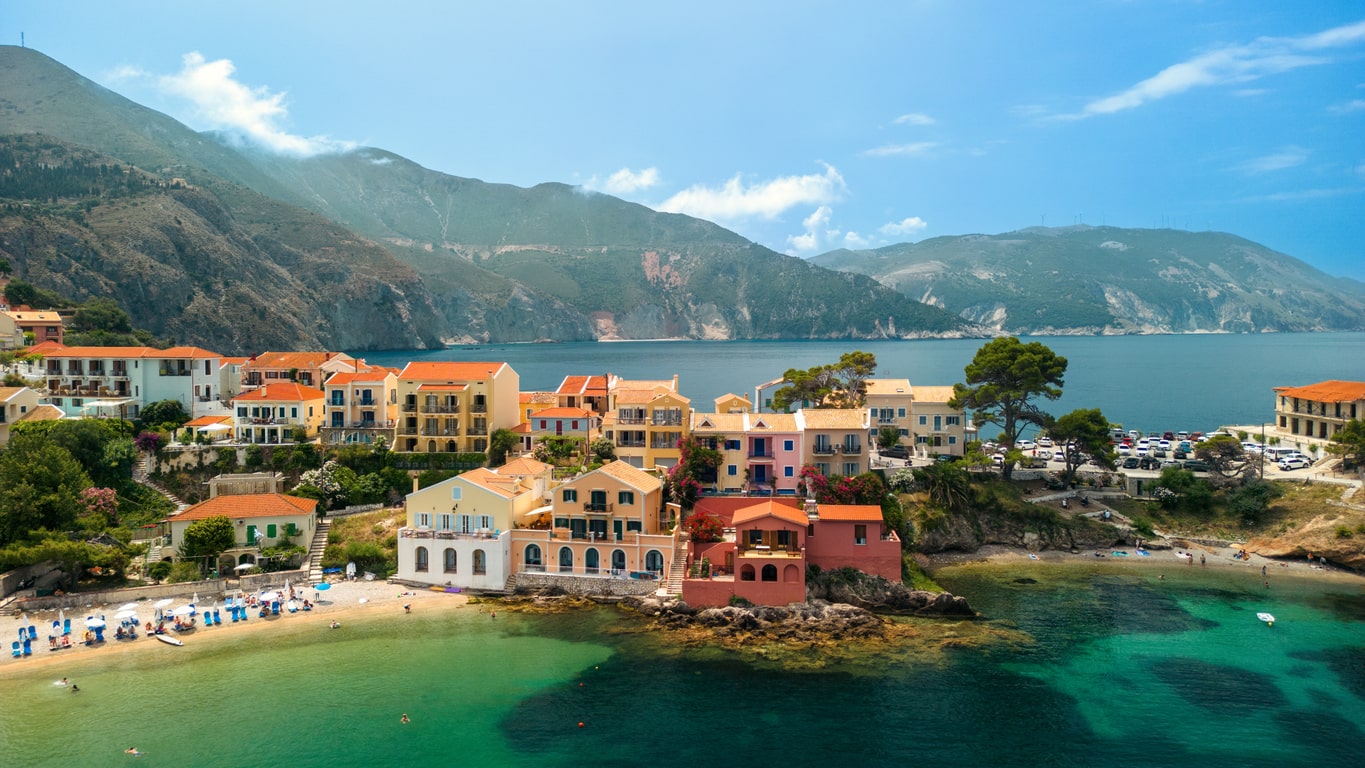
Assos is located on a narrow peninsula, beneath a 16th-century Venetian castle, its pastel-coloured houses arranged in a curve around a harbour protected from the sea. Fiskardo, at the northern end, is one of the few settlements that escaped the 1953 earthquake and thus retains its Venetian-era buildings. Both are inundated with yachts in the summer and have some of the finest tavernas on the island.
Spot Loggerhead Turtles in Argostoli
Loggerhead sea turtles (Caretta caretta) often come up for air in Argostoli harbour at sunrise, being lured by fishermen who are sorting their morning catch near the docks. You can simply see them by taking a quiet stroll along the waterfront before 9 AM. Keep a safe distance. Feeding or touching the turtles is strictly forbidden.
Cross the De Bosset Bridge
As a part of British rule, the famous Swiss engineer Charles de Bosset created a 690-meter long stone causeway over Argostoli’s Koutavos Lagoon in 1813. This is the world’s longest stone bridge over seawater. Nowadays, it is a pedestrian-only walkway that provides spectacular views of the harbor and the green hills around it.
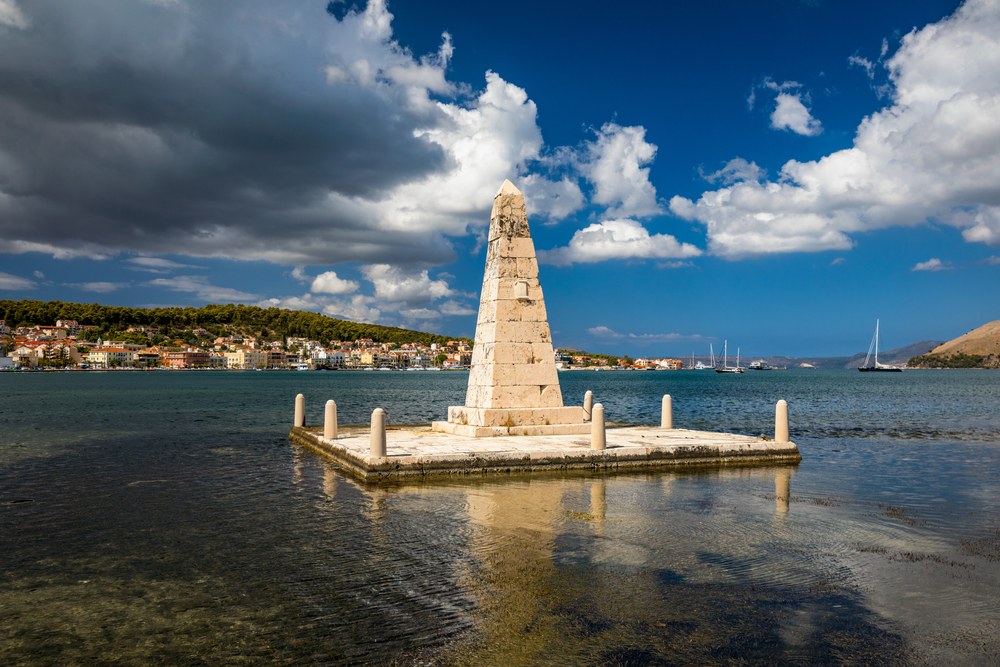
View of the De Bosset Bridge in Argostoli city on Kefalonia island. De Bosset Bridge on lakeside In Argostoli, Kefalonia. Obelisk and the de Bosset bridge in Argostoli, Kefalonia, Greece
Visit Katavothres
A short walk from Argostoli, Katavothres has been known as a geological phenomenon since ancient times. Seawater goes in the cracks of the rocks on the shore, runs through the underground limestone channels and comes out at Melissani Cave, which is located about 14km from the shore. The renovated 19th-century watermill and the explanatory display show how 19th-century scientists managed to find the route by using dye.
Tour the Robola Wineries
At the foot of Mount Ainos, there is the Robola Wine Cooperative, along with a few family-run wineries that produce one of the most famous white wine varieties of Greece. Robola was introduced by the Venetians and is grown on rocky, sun-drenched terraces. Most of the wineries are happy to offer wine tasting and short tours in the vineyard from May to October.
Where to Stay in Kefalonia
If you are wondering where to stay in Kefalonia, the answer depends on your travel style and preferences. For instance, those visiting the island for the first time might find Argostoli and Lassi a good choice as they provide quick and easy access to things.
Fiskardo attracts couples and yacht crowds, while Skala is the perfect spot for families who are planning long stays on the beach. Sami is an excellent base for exploring the caves and Mount Ainos, and the north part of the island remains largely untouched.
Argostoli and Lassi: Best for First-timers
Argostoli and Lassi are very suitable spots for first-time visitors. This attractive town is the vibrant capital of the island where you can find a pleasant water-front promenade and the central square. Plenty of restaurants and shops are within a walking distance.
Lassi is only 5 minutes to the south where it is closer to Makris and Platis Gialos beaches, while it is a lot quieter at night. The majority of the accommodation consists of mid-range hotels and family-run guesthouses however there are also few boutique options near the harbour.
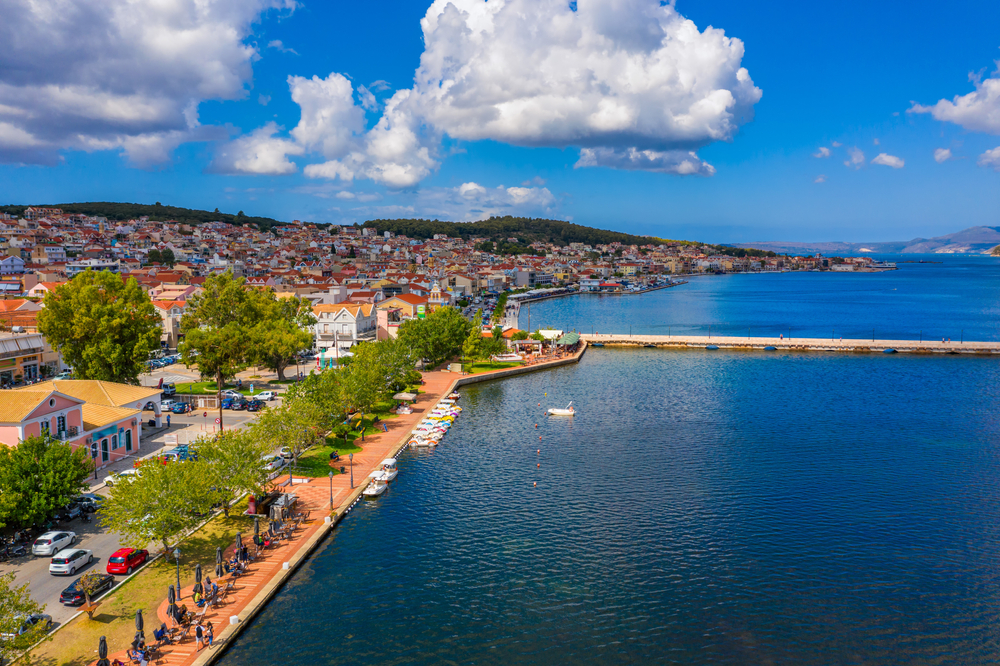
Aerial drone view of Argostoli (Argostolion), famous city and capital of Cefalonia (Kefalonia) island, Ionian islands, Greece. Argostoli town, former municipality on the island of Kefalonia, Greece.
Fiskardo: Best for Couples and Yacht Crowd
Fiskardo, with its postcard appeal and delightful pastel Venetian houses surrounding a tiny harbor full of yachts during summer, is the most picturesque village on the island. It’s also considered as the best place for couples and the yachting crowd. Accommodation here is mainly high-end – boutique hotels, restored stone houses, and waterfront apartments. Restaurants are also very good. Beaches like Foki and Emblisi are within a short drive or walk.
Skala: Best for Families and Beach Holidays
Skala, situated on the southeast coast, is fronted by a three-kilometer long sandy beach with shallow water and full beach facilities. Skala is best for those planning family-friendly trips in Greece. The town is centered around the beach and family-friendly hotels, all-inclusive resorts, self-catering apartments, and rental villas. Restaurants and shops are within walking distance.
Sami: Best Base for Caves and Mount Ainos
Sami, a port town on the east coast, is not only a great location for a base to explore the famous caves of Melissani and Drogarati but also offers easy access to Mount Ainos National Park. Accommodation options here are more practical than luxurious with small hotels, guesthouses, and apartments. Antisamos beach is just a five-minute drive from Sami.
Assos and the North: Best for Romance and Seclusion
Assos along with the rest of the north side is where you will find the most romantic lodging on the island, such as elaborate stone villas with sea views and boutique hotels nestled in the pretty hill villages. The atmosphere is calm, beautiful, and unhurried, perfect for couples or those planning honeymoon trips in Greece. Myrtos beach is a short drive south.
What to Eat in Kefalonia
The island’s cuisine is a delightful Mediterranean blend with a strong Venetian influence. It heavily features delicious meat pies, naturally grown wild greens, local cheeses, and Robola wine. Rather than sophisticated or elaborate, the food is more of a rustic and festive nature. Recipes have been handed down from generation to generation, and most of the raw materials are still produced, raised, or caught on the island.
Signature Dishes to Try
Below are the staple items of traditional Kefalonian cooking. They can be seen almost everywhere in the island’s village tavernas. Each of them is tied to local agricultural, fishing, or festive customs.
- Kreatopita: a rich meat pie made with pork, lamb, or beef, mixed with rice, garlic, and herbs. The island’s most celebratory dish.
- Bakaliaropita: a dish of salted cod pie with onions and garlic is very much liked.
- Riganada: a simple dish where dry bread is soaked in water and vinegar, then drizzled with olive oil, and finally topped with tomatoes and oregano.
- Aliada: a delectable potato and garlic dip that resembles skordalia, usually accompanied by fried fish or boiled meat.
- Tsigaridia: wild greens like chard, spinach, and leeks cooked in a tomato sauce with spices.
- Strapatsada eggs: cooked with fresh tomatoes and crumbled feta, a comforting dish for breakfast or a quick lunch.
Alt text: Slice of kreatopita on a white plate, showing layers of pastry and meat filling topped with grated cheese and herbs.
Local Cheeses, Sweets, and Wine
The island offers a few distinctive and delicious products, which you can find at markets, bakeries, and wineries, apart from main dishes.
- Cheeses: feta, the hard and salty kefalotyri, and the creamy local pretza, which is often eaten with bread and olives.
- Sweet treats: Mandolato (a chewy almond nougat with Venetian roots) and pastokidono (a dense quince paste studded with almonds).
- Robola wine: a fresh and citrus-flavored white wine cultivated on the stony inclines of Mount Ainos, with an annual production of about 500 tons and exports to Europe and the United States.
Kefalonia Culture and History at a Glance
Kefalonia’s identity is multi-layered, with Venetian, French, British, and Greek rulers having left their marks on the architecture, dialect, and cuisine. The great 1953 earthquake leveled most of the island’s historic buildings, with only Fiskardo in the north being unaffected. The island was introduced to international viewers through the film Captain Corelli’s Mandolin, which was largely shot on Antisamos.
Music is a fundamental part of the culture. The Ionian School of composition and the kantades serenade tradition are still very much alive and performing during summer evenings. The island hosts two major festivals that everyone looks forward to: Saint Gerasimos in August and the Varkarola boat-singing festival in Assos.
Alt text: Close aerial view of Assos with pastel houses perched along the shoreline above clear water and a small beach below.
Suggested Kefalonia Itinerary (5 – 7 Days)
If you’re planning a trip to Greece, this Kefalonia itinerary is a great starting point. You can also explore customized Greece itineraries tailored to your travel pace and interests. This itinerary is mainly for those who rent a car, and the most convenient base for the first half is Argostoli or Lassi, with a possibility to move north for the last few nights.
- Day 1: Argostoli: Get familiar with your surroundings, stroll along the De Bosset Bridge, spot the turtle loggerheads in the harbour either at dawn or in the late afternoon.
- Day 2: North coast: Take a trip to Myrtos for a view of the beach and a swim, then make your way to Assos and Fiskardo for sunset.
- Day 3: Caves and east coast: Discover Melissani and Drogarati caves, have lunch in Sami, swim at Antisamos.
- Day 4: Mountains and wine: Trek Mount Ainos in the morning, visit a Robola vineyard in the afternoon.
- Day 5: South coast: Go beach hopping. Skala Katelios, and Xi.
- Days 6 – 7: Paliki Peninsula: Visit Petani, Lixouri, and have slow beach days.
Practical Tips for Visiting Kefalonia
A few logistical details save time and money on the ground:
- Currency: Euro. Most restaurants and hotels accept cards, but smaller tavernas and beach kiosks still prefer cash.
- Rent a car: Essential. The island is around 50km long with limited public transport.
- Choose a smaller car: Roads are narrow, winding, and often cliffside.
- Travel May – October: Most tourist services close from November through March.
- Pack water shoes and strong sun protection: Beaches are mostly pebbly, with limited natural shade.
Alt text: Petani Beach with vivid blue water, a wide sandy shoreline, and steep cliffs surrounding the bay.
Conclusion
Kefalonia is an island suited to those who don’t want to rush through locations and take their time exploring and enjoying the local culture, food and sights. Kefalonia offers world-class beaches, beautiful natural landmarks like underground caves and a rich culture shaped by Venetian, British and Greek influence. Not to mention the amazing food and local wines like Robola!
So, if you are ready to give Kefalonia and Greece a try, get in touch with Greece Insiders! A team of travel experts will design an itinerary made just for you or you can explore some of the ready-made packages and find one that fits your criteria!
Feeling Ready?
From our blog
Aliki Beach, Paros: Three Beaches, One Name
READ MORE
Ioannina, Greece: The Lake City Between Athens and Corfu
READ MORE
Kalamata, Greece: How to Get There, What to See, When to Go
READ MORE
Logaras Beach, Paros: Where to Swim When the Sun Bites
READ MORE
Athens to Santorini: Ferry or Flight? (2027 Guide)
READ MORE
Athens to Santorini: Ferry or Flight? (2027 Guide)
READ MORE
Piso Livadi Beach, Paros: Sand, Tavernas and the Boat Out
READ MORE
Aegina, Greece: A Practical Island Guide (2026)
READ MORE
Spetses, Greece: Everything you need to know (2026)
READ MORE