Ioannina, Greece: The Lake City Between Athens and Corfu
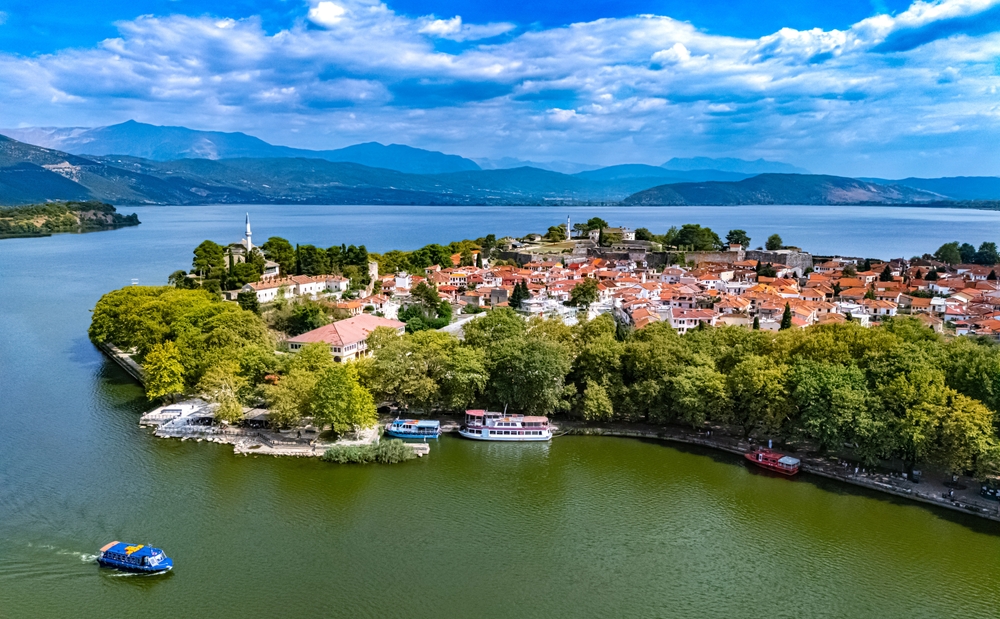
Ioannina, Greece is a lake city in the mountains of Epirus, about 411 kilometers northwest of Athens and a little over an hour from the ferries to Corfu. You say it yo-AH-nee-na. Most Americans drive past it on the way to somewhere else, which is the best argument for stopping.
This guide covers how to get there and what the museums cost, with the ticket prices. It also covers the island in the middle of the lake and the man who was killed on it, then the day trips into Zagori and when to come.
Is Ioannina worth visiting?
Yes, if you want a real Greek city rather than a resort. Ioannina, Greece is exactly that. Ioannina has about 65,000 people in the city proper, around 20,000 university students, an Ottoman walled quarter still lived in, and a lake with an inhabited island in it. Furthermore, it costs a fraction of the islands, and almost nobody American goes.
But here is the honest case against. The lake is not swimmable. The city is a working place with traffic and apartment blocks around a beautiful core, not a postcard from end to end. And it rains. One travel data site puts it at 1,100 millimeters a year, which would be more rain than London gets. So if your two weeks in Greece are your only two weeks in Greece, spend them on an island. On the other hand, if you have been before, or you are driving between Athens and Corfu, Ioannina is the best stop on that road.
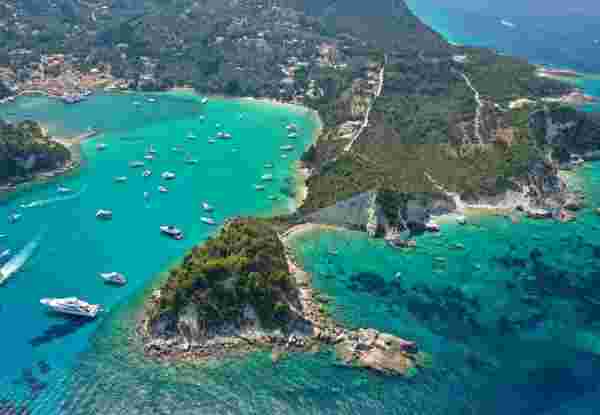
It also pairs oddly well with the quieter islands. Travelers who liked Paxos, just off this coast, tend to like Ioannina for the same reason. In both places the day is shaped by what the locals are doing, not by what the visitors want.
How to say Ioannina
Yo-AH-nee-na. Four syllables, stress on the second.
Wikipedia gives the formal pronunciation as i.oˈanina. Locals shorten it, and a British travel writer who spent ten days there describes what she heard: “pronounced ‘Yannena’ but if you listen to a local say it, there is a very gentle ‘ee-oh’ at the front of it.”
You will also see the city written as Yannina or Janina in older books and on some bus timetables. Same place.
How to get to Ioannina
By air
Ioannina National Airport sits 5 kilometers from the center, about 15 minutes away, and takes domestic flights from Athens. It is small, so schedules are thin outside summer.
Three other airports are worth knowing about if the Ioannina flights do not suit you. Corfu is a ferry and a drive away, and Preveza is south down the coast. Finally, Igoumenitsa is the ferry port 80 kilometers west where the boats from Italy and Corfu land. Nobody writing about Ioannina mentions these. Yet they often solve a routing problem that the small airport creates.
By road and bus
The drive from Athens is 411 kilometers and about four and a half hours on the modern motorways. From Thessaloniki it is 260 kilometers and around three hours on the Egnatia Odos, which is one of the more spectacular motorways in Europe once it climbs into the Pindus.
The KTEL intercity bus takes six to six and a half hours from Athens and about three from Thessaloniki. A coach costs far less than flying, and it drops you in the city, not at an airport.
One note on sources. Wikipedia gives the Athens distance twice on the same page, as 410 kilometers in one place and 436 in another. The 411 above comes from the Greek national tourism board, which is the figure we would trust.
Lake Pamvotida and the island
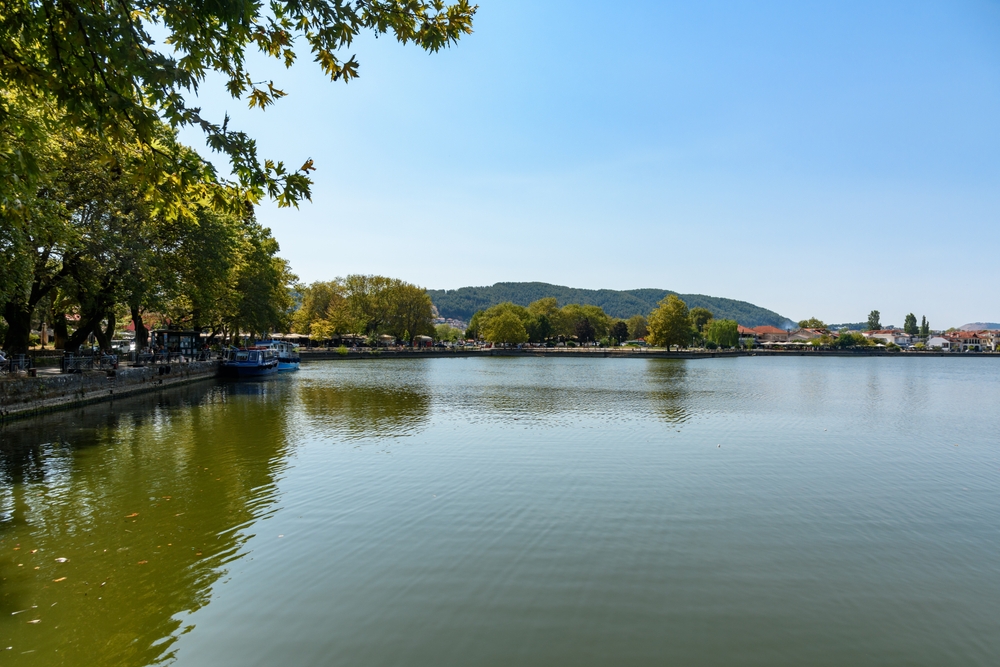
Lake Pamvotida is the reason Ioannina, Greece is here. The name means roughly “she who feeds everyone,” and at around three million years old it is one of the oldest lakes in Europe. Behind it, in turn, Mount Mitsikeli rises 1,810 meters.
You should not plan on swimming in it. The lake is eutrophic, which means it is heavy with nutrients and prone to algae, and the one travel site that mentions it at all describes the lake as not used for swimming. We could not find a municipal water-quality statement either way, so treat this as a strong warning rather than a legal prohibition. Locals swim in the rivers, and so should you. Meanwhile every other guide to this city leaves the question out and lets you discover it on arrival.
So what you do instead, as everyone in Ioannina, Greece does, is take the boat across to the island.
Getting to the island
Boats leave from the Ioannina, Greece waterfront, and the crossing takes about ten minutes. The national tourism board records departures every thirty to sixty minutes. On price, two figures circulate and they do not agree. A visitor who made the crossing and wrote down what she paid records €2.50 per person with Nisaki Lines. A data-driven travel site publishes $3 return with no source and no author. Take the €2.50 as the one somebody handed over.
To begin with, the island has no cars. In size it is roughly 800 by 500 meters, only about a quarter of it built on, and it rises 59 meters above the water. Around 200 people live there. There are six or seven monasteries depending on how you count, the oldest being Agios Nikolaos Filanthropinon, founded in 1291, with Agios Ioannis Prodromos following in 1506.
However, not all of them open. In winter expect two. The frescoes in the ones that do open run from the thirteenth century to the sixteenth, and they have never been restored into brightness.
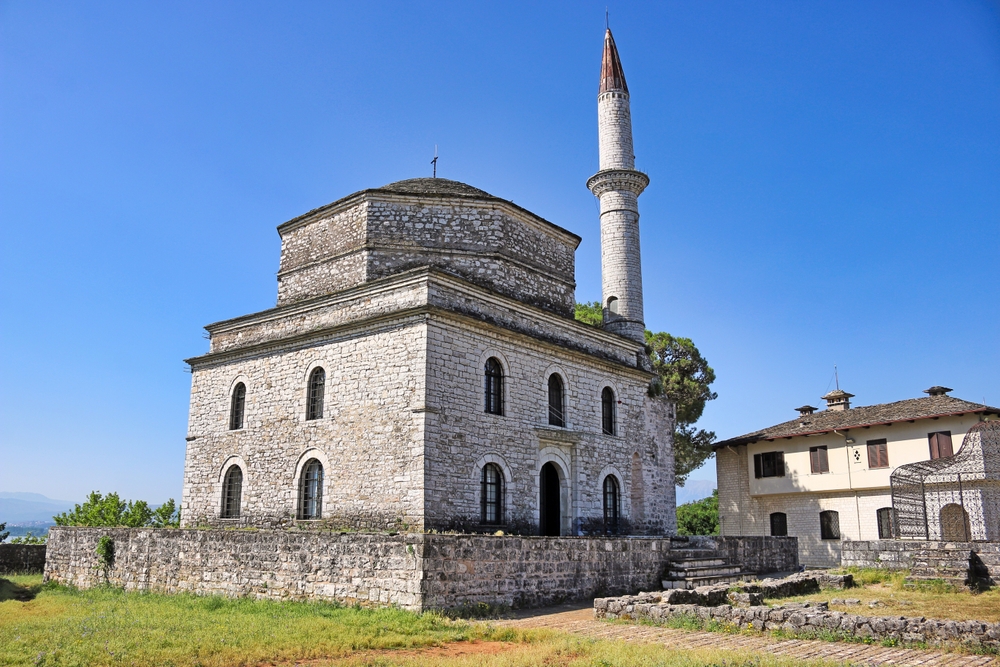
The castle, Ali Pasha and Kyra Frosini
The Kastro is the walled Ottoman quarter of Ioannina, Greece, beside the lake. In fact the tourism board calls it the oldest continuously inhabited Byzantine fortress in Greece. People still live inside the walls. Besides the houses, the Fethiye Mosque inside it dates from 1430.
Above all, though, the story that hangs over the place belongs to Ali Pasha.
Born in Tepelene, in what is now Albania, he lost his father to murder at fourteen. By 1788 he governed Ioannina, and he ruled the region for more than thirty years as something close to an independent prince, playing the Ottomans, the British and the French off against one another. In July 1820 the Sultan declared him a traitor. He held out for eighteen months while the army besieged the city. Then, in 1822, he was cornered in the monastery of St Panteleimon on the lake island, shot through the floorboards from the room below, and beheaded. The bullet holes are still in the floor.
The monastery is now the Ali Pasha and Revolutionary Period Museum, which opened in 2012.
Kyra Frosini and the lake
Darker still is the story of Kyra Frosini. She was the mistress of Ali Pasha’s son. In the telling that survives, Ali had her and seventeen other women arrested. They were sewn into weighted sacks and rowed out into the middle of the lake at night to be drowned. Greek folk song has carried her name for two hundred years. Whether the number is exactly right is impossible to verify. We are repeating a tradition rather than a court record. Even so, it is the thing every local will tell you about that water.
What a day in Ioannina costs
Almost nobody publishes what a day in Ioannina, Greece actually costs, so here it is with the sources attached.
Museum tickets and opening hours
Every figure in this table comes from the Greek national tourism board’s Ioannina page, last updated in August 2026.
| Museum | Ticket | Opening hours |
|---|---|---|
| Archaeological Museum | €6 (€3 reduced) April to October, €3 November to March | 08:30 to 15:30, closed Tuesdays |
| Municipal Museum of Ioannina | €4.50 (€2.50 reduced) | 08:00 to 15:00 winter, 08:00 to 20:00 summer |
| Silversmithing Museum | about €4 (€2 reduced) | 10:00 to 18:00 from 1 March, 10:00 to 17:00 from 16 October, closed Tuesdays |
| Ali Pasha Museum, on the island | €3.50 (€3 reduced) | 09:30 to 18:00 |
| Kostas Frontzos Folklore Museum | €2 | 09:00 to 15:30 weekdays, 09:00 to 14:30 Saturday |
| Municipal Art Gallery | Free | 08:00 to 15:00 Monday to Thursday, 08:00 to 21:00 Friday |
Two of the best things in the city cost nothing. Walking the castle walls is free, and so is the gallery.
Food, drink and beds
These come from a travel data site that publishes no author and no date, so treat them as a guide rather than a quote. It gives a backpacker day at about $40, a mid-range day at $85 and a luxury day at $175, and describes Ioannina as the cheapest destination in its whole Greek set by a clear margin.
Its itemized figures run as follows. To begin with, a Greek coffee is around $2.50 and a slice of hortopita around $3.50. A bottle of tsipouro with mezedes comes to about $8, a mid-range dinner for one about $24, and a day pass on local transport about $3. In euros it puts a portion of pites at €3 to €8, an evening of tsipouro at €12 to €18, Zagori trout at €12 to €18, and a central hotel room under €90.
By contrast, day tours are the expensive part. On GetYourGuide, an easy rafting trip on the Voidomatis starts at £39 for three hours, a full day guided into Zagori at £120, and a private Zagori day at £206. Prices were read on 24 September 2026 and will move.
What else to do in Ioannina
The silver. First, Ioannina has been a silversmithing town for centuries and still is. Today the Silversmithing Museum sits in the southeastern citadel of the castle, and the workshops and shops around it are the real reason to go, more than the museum itself.
The Jewish quarter. This is the part of Ioannina that almost no travel guide tells properly. Every figure in this paragraph comes from Wikipedia’s account of the city, which cites the community’s own records. A Jewish community is attested here from 1319, Romaniote Jews who spoke Greek and had been in the country since antiquity, not Sephardic arrivals. The synagogue inside the castle walls was built in 1829 and still stands. In April 1941 there were 1,950 Jews in Ioannina. On 25 March 1944 the Nazis deported 1,870 of them, and the train reached Auschwitz-Birkenau on 11 April. Only 181 are known to have survived. By 2008 the community was about fifty mostly elderly people. In 2019 Ioannina elected Moses Elisaf, a doctor, as its mayor, the first Jewish mayor of any Greek city.
Not far away, Perama Cave, four kilometers out of town and about ten minutes away, is one of the larger cave systems in Greece and an easy hour.
The university. Ioannina, Greece has one of the larger student populations in the country. Founded in 1964 and independent since 1970, it is why a city this size has the bar and cafe scene it does. The tsipouradika fill up on weeknights in a way they would not in a town without students.
Day trips: Zagori, Vikos, Metsovo and Meteora
This is where Ioannina, Greece earns a second and third night, and where most of the money in the region is made.
To the north, Zagori is a region of some 45 stone villages in the Pindus, connected by old packhorse bridges, with Monodendri and Papingo the two most visited. It is about an hour from the city.
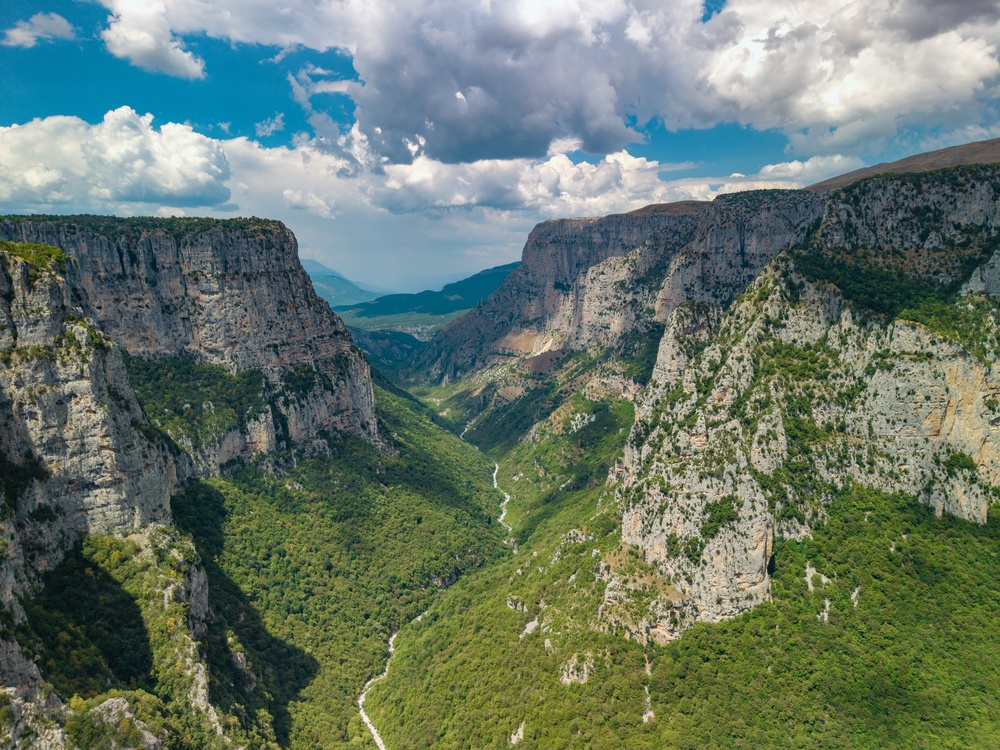
The Vikos Gorge
The Vikos Gorge, though, is the headline. It runs 32 kilometers and the Guinness Book lists it as the deepest gorge in the world relative to its width. For instance, the viewpoint at Beloi above Monodendri is a short walk for a very large view; the full gorge hike is a serious day. Reckon on roughly 50 kilometers and an hour to the trailheads.
Dodoni, 22 kilometers south and about 25 minutes, is the oldest oracle in Greece, older than Delphi, with a theater seating around 15,000. There is no queue and often no coach party, which is not something you can say about Delphi.
Metsovo, 55 kilometers and 45 minutes east, sits at 1,150 meters and is where the metsovone cheese comes from. It is a mountain town, not a village, and it still works in winter when Zagori is snowed in.
Meteora, lastly, is about two hours away, which makes it a long day trip from Ioannina but a natural stop if you are driving on toward Thessaloniki or Athens.
If the villages are what draw you more than the city, our guide to the best villages in Greece puts Zagori in context alongside the mainland and island alternatives.
What to eat
Ioannina, Greece cooks differently from the islands, and the difference is mountains. As a result there is very little fish beyond what comes out of the lake, and a great deal of pie.
So pites are the regional obsession: hand rolled filo filled with greens, cheese, pumpkin or meat, sold by the slice in every bakery and eaten at any hour. A portion runs €3 to €8. Try hortopita, the wild greens version, which is the one the region is known for.
Alongside them, tsipouro is the drink, a clear spirit served by the small bottle with a procession of mezedes that arrives whether you ordered it or not. A tsipouradiko evening comes to €12 to €18 and functions as dinner. This is what the students are doing on a Tuesday.
Metsovone is the smoked cheese from the mountain town up the road, and it turns up grilled on most menus. Zagori trout comes from the rivers in the gorge. The lake itself supplies eel, crayfish and, for the curious, frog legs, which appear on island menus as batrachopodara and are not a tourist gimmick.
Getting around Ioannina
In the city itself, of course, you will walk. The castle quarter, the waterfront, the museums and the boat jetty all sit within about twenty minutes of each other on foot. The lanes inside the walls are barely two meters across in places, so a car is a liability there.
For anything further out in Ioannina, Greece, however, there are city buses, and a day pass runs around $3. Taxis wait on the main square and a cross-town fare is a few euros.
A rental car, however, changes what the trip is. Without one you have the city, the island and whatever tours you book. With one you have Zagori, Dodoni, Metsovo and the option of driving on to Meteora or the Corfu ferry. If you are coming for more than two nights, take the car.
Be warned that parking inside the Kastro is the one real headache. Instead, leave the car below the walls and walk up.
Where else this fits in a Greece trip
In practice, Ioannina, Greece rarely stands alone. It works as the mainland half of a trip whose other half is water.
Naturally, the first pairing is the Ionian, because you are two hours from the Igoumenitsa ferries. The Saronic islands work differently, as a short break from Athens at the other end of the country. We have written separately about Aegina, the closest inhabited island to the capital, and about Spetses, the one people confuse with Hydra.
Further out, the Dodecanese and islands such as Symi sit at the opposite corner of the country and belong to a different trip entirely. Mentioning them here is a warning as much as a suggestion: Greece is larger than it looks on a map, and trying to combine Epirus with the eastern Aegean in ten days is how good holidays get spent on ferries.
When to visit Ioannina
May, June, September and October. That is not a compromise. It is the answer for Ioannina, Greece.
Summer highs reach around 32°C and the lake brings mosquitoes with it. Winter is properly wet: November gets around 190 millimeters of rain and December around 175, and the mountain roads into Zagori need snow chains. The upside of winter is Metsovo and an empty castle. Moreover, the city does not shut down the way an island does, so it is a real option if you know what you are choosing.
In spring, by contrast, you get the Zagori rivers at full flow and wildflowers. September and October give you warm days, walkable temperatures in the gorge and the students back in town. Our guides to Greece in November and the weather in December go month by month if you are weighing up the shoulder season across the country, and our winter guide covers what stays open.
Where to stay
In Ioannina, Greece the answer is simple: stay in or just below the Kastro if you can. The walled quarter is where the atmosphere is, the lake is at the bottom of it, and you can walk to everything in this guide except the cave and the day trips.
Alternatively, the waterfront along Molos is quieter, with the lake in front of you. Central rooms run under €90 in normal seasons, which is roughly half what the same standard costs on a popular island in August.
Guesthouses up in Zagori cost considerably more than hotels in the city. In addition, they get booked months ahead for autumn weekends. If you want the villages, book those first and fit the city around them.
Finally, there is a third option people rarely consider. Because the island has around 200 residents and a handful of rooms, you can stay out there. The last boat back is early. Afterwards the tavernas empty out, which is either the best thing about the island or a reason to stay on the mainland, depending on what you came for.
Should you go?
Ioannina is the city Americans drive past on the way to the ferry, and it is a better stop than most of the places they are driving to. Ioannina, Greece gives you an Ottoman quarter people still live in, a monastery island ten minutes offshore, the deepest gorge in the world an hour up the road, and dinner for the price of a coffee in Santorini.
If you want it built into a route rather than worked out from scratch, that is what we do. Our Greece vacation packages are put together one trip at a time. Epirus already sits inside one of them: a ten day Greek Easter journey running Athens, Delphi, Meteora and Zagori before it finishes on Corfu. It includes a private hike in the Vikos Gorge, and it runs around Orthodox Easter rather than all spring.
Frequently asked questions
How do you pronounce Ioannina?
Yo-AH-nee-na, with the stress on the second syllable. Older books and some bus timetables spell it Yannina or Janina, and that is the same city.
How much does a day in Ioannina cost?
Budget roughly €35 to €45 a day if you are eating in bakeries and tsipouradika and staying in a simple room, and about double that for a central hotel and a sit-down dinner. Museums are the cheap part, at €2 to €6 each. The expense that changes the total is a guided day into Zagori, which runs from about £39 for a short rafting trip to £206 for a private day.
What is the nearest airport to Ioannina?
Ioannina National Airport, five kilometers from the center and about fifteen minutes by road, with domestic flights from Athens. Schedules thin out in winter, so many visitors fly to Corfu, Preveza or Thessaloniki instead, or take the coach from Athens.
What is Ioannina famous for?
Ali Pasha, who ruled here from 1788 until 1822 and was killed on the lake island; Lake Pamvotida and its monasteries; silversmithing, which the city has practiced for centuries; and being the gateway to the Zagori villages and the Vikos Gorge.
Where should you base yourself for the Vikos Gorge?
Ioannina works if you want a city in the evenings and are happy with an hour of driving each way. If the gorge is the point of the trip, sleep in Monodendri for the Beloi viewpoint and the Oxya side, or in Papingo for the northern end and the Voidomatis. Zagori guesthouses cost more than city hotels and fill up months ahead for autumn weekends.
How long do you need in Ioannina?
Two nights for the city, the castle and the island. Three or four if you want Zagori and the Vikos Gorge properly, which is what most people end up wanting.
Feeling Ready?
From our blog
Aliki Beach, Paros: Three Beaches, One Name
READ MORE
Ioannina, Greece: The Lake City Between Athens and Corfu
READ MORE
Kalamata, Greece: How to Get There, What to See, When to Go
READ MORE
Logaras Beach, Paros: Where to Swim When the Sun Bites
READ MORE
Athens to Santorini: Ferry or Flight? (2027 Guide)
READ MORE
Athens to Santorini: Ferry or Flight? (2027 Guide)
READ MORE
Piso Livadi Beach, Paros: Sand, Tavernas and the Boat Out
READ MORE
Aegina, Greece: A Practical Island Guide (2026)
READ MORE
Spetses, Greece: Everything you need to know (2026)
READ MORE