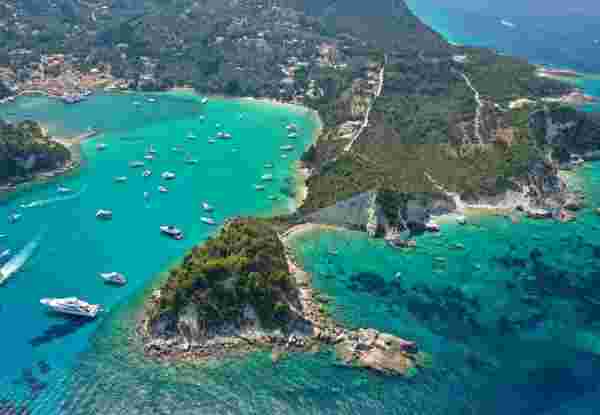
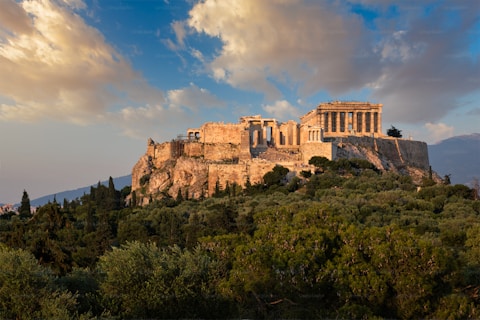
Aegina, Greece: A Practical Island Guide (2026)
By Anthia, Greece Insiders
Aegina, Greece is the closest inhabited island to Athens, about 27 kilometers out and half an hour from Piraeus on the fastest boat. Sandy beaches, a working fishing harbor, a Doric temple from around 500 BC, and pistachio groves inland. Most visitors give it four hours between ferries.
This guide covers what the crossing costs and how to reach the beaches by bus for under two euros. It also covers when the sea is warm enough to swim, and whether you should be going to Hydra instead.
Is Aegina worth visiting?
Yes, and especially if you want an island that still works for a living. Aegina has a year-round population of 12,911 at the 2021 census, fishing boats that go out in the morning, and pistachio farms inland. It is not a resort, and it sits closer to the city than the Athens Riviera feels once you are on the water. If you are pairing it with time in the city, our guide to the top destinations near Athens covers what else is within reach. Anyone hoping for nightlife and boutique hotels will be disappointed. But if you want a Greek island that has not been rearranged for visitors, this is the closest one to Athens.
What sets it apart is mostly the sand. Real sandy beaches are rare this close to the mainland, and Aegina has five or six of them, all reachable by a bus that costs under two euros. The Temple of Aphaia is the other draw: one of the best-preserved Doric temples in Greece, and almost never crowded.
The case against is worth stating too. Aegina has no dramatic caldera view, no famous sunset, and no hotel anyone photographs. Athenians come here at weekends, so July and August feel busier than the visitor numbers suggest. If your trip to Greece is short and you want the postcard, go to Santorini instead. If you have already seen the postcard, Aegina Greece is the better second island.
How to get to Aegina from Athens
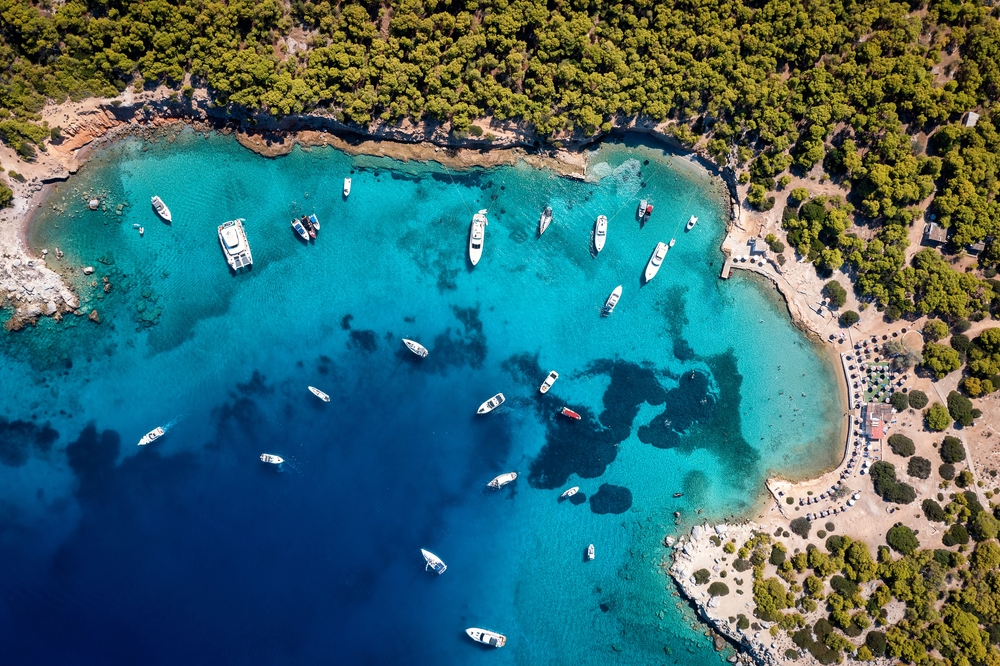
Ferries leave from Piraeus, the main port of Athens, and there is no airport on the island. During summer the route runs more than 40 crossings a day, so you rarely wait long. Winter service drops sharply, and published figures for how far it drops disagree with each other, so check the timetable rather than trusting a number.
Ferry times, fares and operators
| Vessel type | Journey time | One-way adult fare | Takes cars? |
|---|---|---|---|
| Conventional ferry (Saronic Ferries) | 1 hour 10 minutes | €12.00 | Yes, from €29 |
| Conventional ferry to Souvala | Not published | €11.00 | Yes, from €23 |
| Hydrofoil (Aegean Flying Dolphins) | 40 minutes | around €18 | No |
| High-speed catamaran (Magic Sea Ferries) | 30 minutes | about €20 | No |
Two notes on that table, because the difference matters. The €12 and €11 fares come from Saronic Ferries’ own price list, so they are the operator’s published prices. The hydrofoil and catamaran fares come from booking sites rather than the operators themselves, which do not publish fares outside their booking engines. Treat those two as close, not exact. Across all operators the route sells between €9.50 and €25 one way.
Boats start early and finish late. The first departure from Piraeus is around 06:00 and the last is around 20:45, with the last boat back from Aegina around 20:50. Saronic Ferries puts its own final Piraeus departure somewhere between 19:45 and 21:30 depending on the season and how busy the route is, which tells you how much these times move. Check on the day.
Which ferry should you take?
Take the slow one. It costs less, it carries cars, and an hour on an open deck watching the Saronic Gulf go past is not time you lose. The fast boats save you half an hour and cost around 50% more.
There is one case for the hydrofoil: a day trip where you want maximum hours on the island. Leave on the 06:00 conventional ferry and come back on a fast boat in the evening. That gives you a full day for the price of one premium ticket instead of two.
You do not need to book ahead as a foot passenger outside August. If you are bringing a car, book, and arrive early. Only the conventional ferries take vehicles, which is roughly half the daily departures.
Aegina or Hydra?
This is the question most people planning a day or two out of Athens are actually asking, and it is oddly hard to find a straight answer to. The two islands sit close together and work completely differently. Poros is the third name that comes up in the same conversation, and it behaves more like Aegina than like Hydra: roads, buses, a car ferry. We cover it in our guide to the islands nearest Athens.
| Aegina | Hydra | |
|---|---|---|
| Size | 87.41 km² | 52 km² |
| Population (2021) | 12,911 | 2,070 |
| Distance from Piraeus | about 27 km | 37 nautical miles |
| Cars and bikes | Normal roads, buses, taxis, rental cars | Banned, including bicycles and e-bikes |
| Getting around | Bus from €1.80 | On foot, by donkey, or by water taxi |
| Swimming | Several sandy beaches | Rocky coast, no real sand |
| Feel | A working island with farms and a fishing fleet | A preserved harbor town, no traffic at all |
Hydra’s vehicle ban is not a quaint local custom. It is enforced law covering cars, motorcycles, scooters, bicycles and e-bikes, with garbage trucks as almost the only exception. The government tightened enforcement in May 2025 with a digital vehicle register. Transport on Hydra means walking, a mule, or a boat.
So: pick Hydra if the point of the trip is the harbor itself and the strangeness of a place with no engines in it. Pick Aegina if you want to swim on sand and see a major ancient site without organizing transport around it. Families with small children almost always find Aegina easier. A sandy beach and a bus beat a rocky shore and a two-kilometer walk in August.
We have a separate guide to Hydra if that is the way you are leaning.
The best beaches on Aegina
Sand is what Aegina has that Hydra, Poros and Spetses mostly do not. They are small, mostly sandy, and reachable by bus.
Agia Marina is the biggest sandy beach on the island, on the east coast about 12 kilometers from town. The beach is fully organized, with sunbeds, umbrellas and watersports. This is where families go, and in August it fills up.
Marathonas is two sandy beaches roughly 5 kilometers south of Aegina Town, partly organized and much quieter than Agia Marina. It is the easiest good beach to reach if you are staying in town.
Aeginitissa sits halfway along the road between Marathonas and Perdika, in a cove shaded by eucalyptus trees. The shade is the point here, and it is hard to find on a Greek beach.
Klima is a sandy cove on the road toward Sfentouri. The water reads a deep blue because the sand underneath it is bright white.
Souvala sits on the north coast, roughly 9 kilometers northeast of town. A small stretch of sand runs beside a rocky section, and the village is known for its thermal springs. Souvala is the plainest of the six. Families with young children often end up here anyway, because the water shelves gently and the village has a supermarket.
Perdika, 10 kilometers southeast, is a small sandy beach lined with fish tavernas. Most people come for the food and stay for the swim rather than the other way around.
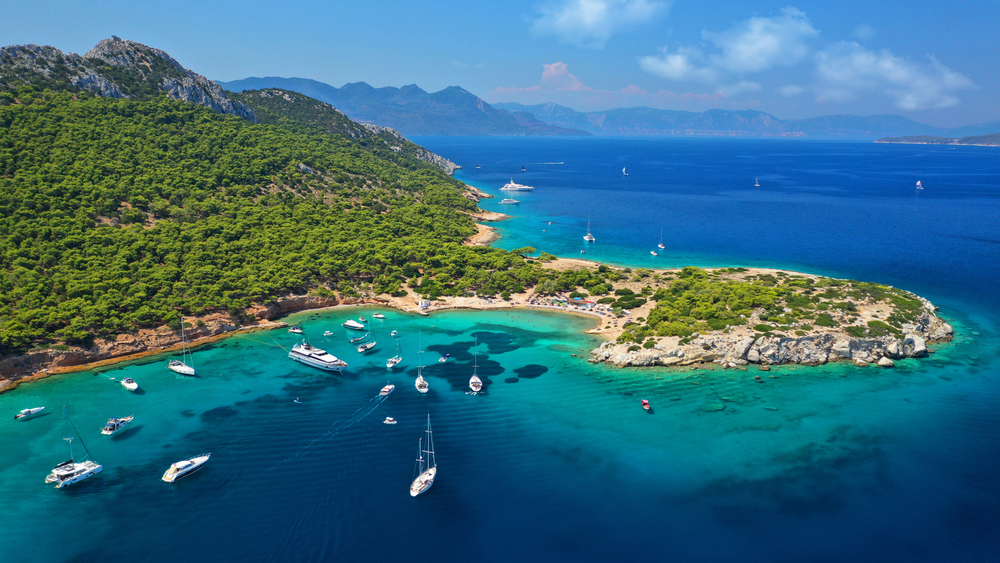
Moni islet
Moni is a small pine-covered island a few minutes off Aegina’s southwest coast, and the boat to it leaves from Perdika. Boats run from April to October, take about 15 minutes, and cost €10 per person with the return leg at €7, per the operator that runs the crossing. Bring cash, because they do not take cards and they do not take reservations. You board first-come and come back on whichever boat suits you.
Moni has deer and peacocks wandering loose, a restaurant, and a beach bar. The swimming is next to pine forest, which is unusual and worth the crossing.
Things to do on Aegina
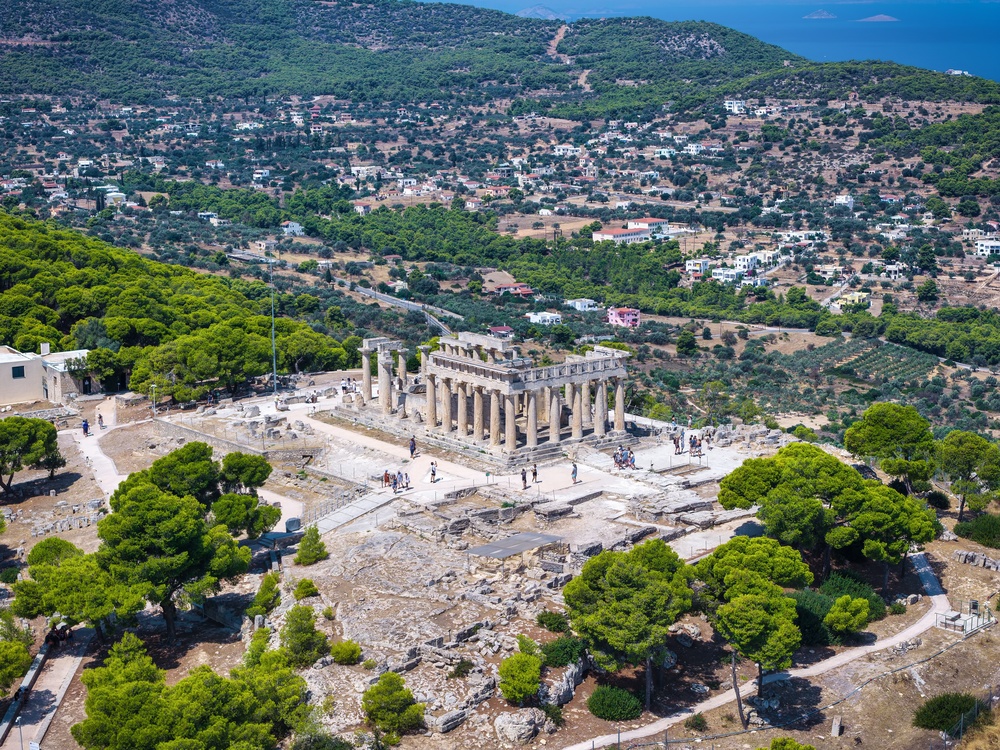
The Temple of Aphaia
The temple was built around 500 BC and it is the reason serious visitors come. Aphaia was a goddess worshipped at this sanctuary and nowhere else in the Greek world, which makes this sanctuary the only place she was ever honored.
Entry costs €6, or €3 reduced. In summer the site opens daily 08:00 to 20:00, and in winter it runs 10:30 to 17:30 and closes on Mondays. Admission is free on March 6, April 18, May 18, the last weekend of September, and October 28. The Ministry of Culture publishes those hours and free days. Its seasonal cutoff dates were last set for an earlier season, so confirm before you plan a day around them.
One thing to know before you go: the sculptures from the temple’s pediments are not on Aegina. They have been in the Glyptothek in Munich since the nineteenth century. The building is close to intact and the carvings are in Germany.
Kolona and the Archaeological Museum
Kolona sits on a hill right beside Aegina Town, and a single €10 ticket covers both the archaeological site and the museum next to it. The museum opens 10:00 to 17:30 and closes on Tuesdays, with Thursdays added to that from November to March.
It is also the oldest museum in Greece. Ioannis Kapodistrias, the first governor of the independent Greek state, founded it on October 21, 1828.
The Monastery of Agios Nektarios
The monastery sits about 6 kilometers from the port and it is one of the busiest pilgrimage sites in Greece. Saint Nektarios founded the convent here in 1904 and retired to it in 1908. He was canonized in April 1961, which makes him one of the most recently recognized saints in the Orthodox calendar.
Dress modestly: covered shoulders, no shorts, long trousers for men. The monastery does not publish visiting hours. Most visitors come on November 9, but there is a second feast day on September 3 that far fewer foreign visitors know about.
Aegina Town and Paliohora
The town itself deserves an hour before you go anywhere. The harbor front is lined with neoclassical buildings from the years when this was the capital. Behind the cafes, the fish market still operates as a market rather than a photo opportunity. Horse-drawn carriages wait at the port. Whether that reads as charming or uncomfortable depends entirely on your view of working horses, and it is worth deciding before a driver asks.
Inland, Paliohora is the ruin of the island’s medieval capital. People built it high and out of sight of the water because of pirate raids. They abandoned it in the nineteenth century, once the coast was safe again. What survives is a hillside of small stone churches, most of them still standing, most of them open. Allow an hour and wear proper shoes.
Getting around the island
You do not need a car. Aegina has three bus lines, all leaving from the station opposite the port in Aegina Town, and they reach every place in this guide. The routes and fares below come from a local island timetable page updated in November 2025; KTEL Aegina publishes its official timetables but not its fares, so treat the prices as current rather than guaranteed and carry small change.
| Line | Route | Journey time | Fare |
|---|---|---|---|
| 1 (yellow) | Aegina Town, Kipseli, Vathi, Souvala, Agii, Vagia | 30 minutes | €1.80 |
| 2 (blue) | Aegina Town, Agios Nektarios, Temple of Aphaia, Agia Marina | 30 minutes | €2.00 |
| 3 (orange) | Aegina Town, Faros, Marathonas, Aeginitissa, Perdika | 20 minutes | €1.80 |
Line 2 is the useful one. For €2 it takes you to the monastery and the temple on the same road, which is the whole cultural half of the island in one ride. Buy tickets at the station or on the bus.
Taxis exist and post indicative prices by route, though the published list is several years old and unofficial, so agree the fare before you set off. As a rough guide it runs around €10 to the monastery and around €18 to Agia Marina or the temple. Rental cars and scooters are available in town if you want to reach the smaller coves.
Where to stay
Most visitors base themselves in Aegina Town, which makes sense: the ferries land there, the buses leave from there, and the restaurants are within walking distance. Rooms here are small hotels and guesthouses rather than resorts, and the walk from the ferry ramp to most of them is under ten minutes.
Agia Marina is the alternative if the trip is mainly about the beach. It is a resort strip in miniature, quieter than the name suggests, and the bus back into town runs regularly. Perdika suits people who want to eat well and swim off the rocks, though you will rely on the bus or a car to reach anywhere else.
One practical warning: the island is a genuine weekend destination for Athenians, so Friday and Saturday nights in July and August book out in a way that Tuesday never does. If your dates are flexible, travel midweek.
When to visit Aegina
Most guides to Aegina skip this, so here are the numbers. One caveat first. These come from Climates to Travel, a climate data compiler using the Saronic reference station. They are not from the Greek meteorological service, which does not publish its figures in a readable form.
| May | Jun | Jul | Aug | Sep | Oct | |
|---|---|---|---|---|---|---|
| Average high | 24°C | 29°C | 32°C | 32°C | 28°C | 23°C |
| Sea temperature | 18°C | 21°C | 24°C | 24°C | 24°C | 21°C |
The sea is comfortable from July to September, and it holds 24°C right through September even as the daytime high drops from 32°C to 28°C. September is therefore the best month to be here, and we have written more broadly about why September works so well in Greece. The water is still summer-warm, the air has come off its peak, the Athenian weekend crowd has gone back to work, and the pistachio harvest is on.
May is beautiful and the sea is cold, though it is a fine month for the Greek islands in general. August is hot and busy, and the ferries and beaches feel it. October still gives you 21°C water, which many people find perfectly swimmable, and our guide to swimming in Greece in October covers that in more detail. If you are choosing between months across the whole country, we have also written about the times of year to avoid.
What to eat on Aegina
Pistachios, first. Fistiki Aeginis holds protected designation of origin status, which ties the name legally to this island in the same way Champagne is tied to its region. (That comes from the regional tourism authority. We could not pull the EU register entry itself, so treat the designation as reported rather than verified at source.) They are sweeter and softer than the pistachios most Americans have eaten. Stalls on the harbor front sell them roasted and salted, alongside pistachio butter, pistachio ice cream and a local liqueur.
The groves are the reason the inland roads look nothing like the coast: low, gnarled trees on terraces, bare in winter and heavy by September. The island celebrates the harvest with Fistiki Fest, held in the port in September. It ran September 12 to 15 in 2024 and September 18 to 21 in 2025. The 2026 dates were not published when this guide went up, so plan for mid to late September and check the festival site nearer the time.
For a meal, go to Perdika. The village is lined with fish tavernas facing the water and the boats land there. Order whatever was caught that morning rather than what you recognize from a menu at home.
Two things about Aegina nobody tells you
Aegina minted the first coins in Europe. The Aeginetic stater appeared around 700 BC, and it made this island the first European city-state to issue its own currency. Coinage itself is older, and Lydia in Asia Minor got there first, but on this side of the Aegean Aegina was the start. The early coins carried a sea turtle, which was replaced with a land tortoise around 456 BC.
Then, roughly 2,500 years later, it did it again. Aegina became the first capital of modern Greece in 1827 under Ioannis Kapodistrias. In 1828 the new state issued its first currency, the phoenix, and every one was struck at the National Mint on Aegina), which operated until 1833. The capital moved to Nafplion in 1829.
So the same small island produced Europe’s first coinage and independent Greece’s first coinage, twenty-five centuries apart. Both happened within a few hundred meters of the modern ferry ramp. There is no plaque, no museum room and no sign, so you will walk past all of it on the way to lunch.
Should you go?
Aegina, Greece is worth two nights if you can spare them. An hour from a capital city of four million people, it still runs on ferry times and the fishing fleet rather than on visitors. Not many islands in the Saronic Gulf can still say that. Come in September, take the slow ferry, use the bus, and give it two nights instead of four hours.
If you are still working out how the islands and the mainland fit together, feel free to reach out or take a look at our Greece vacation packages.
Frequently asked questions
How long is the ferry from Athens to Aegina?
Between 30 minutes and 1 hour 10 minutes, depending on the boat. High-speed catamarans cross in about 30 minutes, hydrofoils in about 40, and conventional car ferries take 1 hour 10 minutes from Piraeus. In summer the route runs more than 40 crossings a day.
How much does the ferry to Aegina cost?
A conventional ferry ticket from Piraeus costs €12 one way at the operator’s published price. Fast boats cost around €18 to €20. Bringing a car starts at €29 each way, so for a two-night trip a car costs more than the two adult fares combined, and the bus reaches everything anyway.
Can you fly to Aegina?
No. Aegina has no airport and no flights. You fly into Athens, then take a ferry from Piraeus, which takes 30 to 70 minutes depending on the boat.
Is Aegina a party island?
No. Aegina has bars and tavernas that stay open late in summer, but it has no club scene and no resort strip. People who want nightlife go to Mykonos or Ios. Aegina’s evenings happen at a table by the water.
Do you need a car on Aegina?
No. Three bus lines run from the port to the beaches, the Temple of Aphaia and the Monastery of Agios Nektarios, and fares are €1.80 to €2.00. Buses thin out considerably in the evening and outside summer, so a car earns its cost mainly in winter, or if you want the small unmarked coves.
Is Aegina good as a day trip from Athens?
It works, but it is tight. A day gives you the harbor, one beach and one ancient site. Two nights lets you see the temple, the monastery, Perdika and Moni without rushing any of it.
Feeling Ready?
From our blog
Aliki Beach, Paros: Three Beaches, One Name
READ MORE
Ioannina, Greece: The Lake City Between Athens and Corfu
READ MORE
Kalamata, Greece: How to Get There, What to See, When to Go
READ MORE
Logaras Beach, Paros: Where to Swim When the Sun Bites
READ MORE
Athens to Santorini: Ferry or Flight? (2027 Guide)
READ MORE
Athens to Santorini: Ferry or Flight? (2027 Guide)
READ MORE
Piso Livadi Beach, Paros: Sand, Tavernas and the Boat Out
READ MORE
Aegina, Greece: A Practical Island Guide (2026)
READ MORE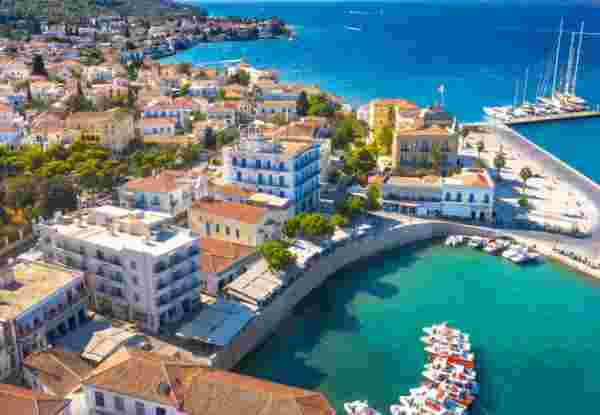
Spetses, Greece: Everything you need to know (2026)
READ MORE